
The most read Vietnamese newspaper
Edition: International | Vietnamese
© Copyright 1997 VnExpress.net. All rights reserved.
The firm, one of Hong Kong’s biggest property developers, has recently reported its second consecutive annual loss, amounting to HK$16.3 billion (US$2.1 billion) for the year ended June 30, according to a company filing cited by Nikkei Asia.
Weaker construction activity, reduced property bookings in mainland China, and asset sales dragged down its revenue by 23% to HK$27.7 billion.
Saddled with HK$146.1 billion in total debt, it is working to ease its financial strain and potentially partner with outside investors, such as U.S. private equity firm Blackstone.
Earlier that same month, Adrian Cheng, 45, once regarded as the heir apparent, exited Chow Tai Fook Enterprises, New World’s parent company, severing his final link to the family’s sprawling business empire.
He had previously stepped down as New World’s CEO last September after the firm posted a record annual loss of HK$19.7 billion, its first in two decades, and later resigned from its board this July.
The third-generation heir’s turbulent chapter at New World began when he took the helm in 2020, four years after the death of his grandfather, Cheng Yu-Tung, who started the family business as a gold shop in the 1940s before expanding into real estate in the 1970s, according to Business Insider.
Described as "bright" and "ambitious," Adrian was said to be a favorite of the late patriarch, per the Financial Times. A Harvard graduate, he began his career at UBS and Goldman Sachs before joining the family business in 2007 and later taking over from his father, Henry Cheng, who had succeeded the late founder before that.
 |
|
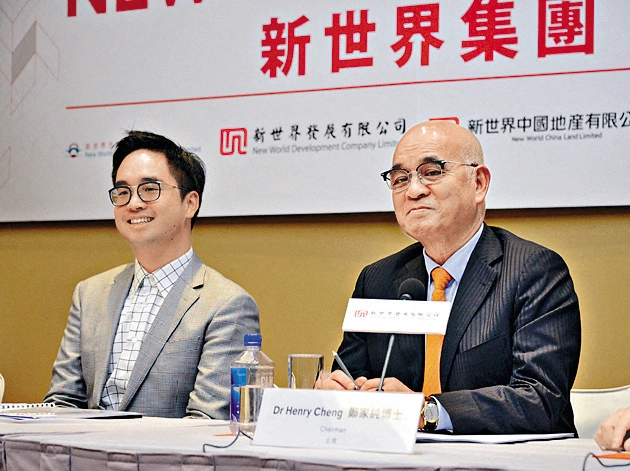
Henry Cheng Kar-shun, right, chairman of family flagships Chow Tai Fook Jewellery Group and New World Development, and his son Adrian Cheng Chi-kong attend a press conference in Hong Kong, China, Sep. 21, 2016. Photo by Imaginechina via AFP |
His rise to CEO was seen as a natural step in the succession of the Chengs—Hong Kong’s third-richest clan with an estimated $19.5 billion in wealth—as his father is already nearing 80.
Once in charge, Adrian pushed for rapid expansion, which saw New World invest heavily in residential and commercial projects across Hong Kong and mainland China. Among them was the HK$20 billion 11 Skies megamall project, a 3.8-million-square-foot complex near Hong Kong’s airport launched in 2018, the South China Morning Post reported.
Insiders told Bloomberg there was an understanding that few ever challenged the boss’s word, which made it hard to challenge Adrian’s ambitious vision.
From the outset, both 11 Skies and another opulent development were hit by setbacks ranging from political unrest and Covid-19 restrictions to rising interest rates and a slowing Chinese economy.
Even as the company’s leverage drew concern, Adrian projected confidence. At a 2023 earnings briefing, he declared: "Other Chinese developers going bust had nothing to do with us because our finances are very solid.
"Secondly we have our brand, thirdly we make premium products."
The Airport Authority Hong Kong has begun exploring new partners to complete 11 Skies, while New World is looking to sell that project to boost liquidity.
 |
|
The 11 Skies project. Photo from Wikimedia Commons/LN9267 |
Following the multibillion-dollar losses, Henry had to step back into the spotlight to steady the builder. He appointed a trusted adviser from outside the family as CEO, a shocking break from tradition in Hong Kong’s property sector.
The firm has also trimmed its workforce, letting go of at least a dozen employees since Adrian’s exit. Meanwhile, the family’s fourth generation is taking shape behind the scenes.
Heirs under pressure
Adrian’s fall also reflects the broader struggles of younger heirs and the complexities of passing down leadership in Hong Kong’s family-run conglomerates.
Today’s heirs are navigating a political and social landscape far different from the one that shaped their predecessors’ rise.
"For decades, the real estate playbook in Hong Kong was quite straightforward. You bid land from the government, you built to maximize it and then you ride a rising cycle," Bloomberg quoted Harry Yu, senior partner for trust and family office advisory at Fung Yu Trust Services, as saying.
Once influential in Hong Kong’s business and policy circles, the city’s wealthiest families now face growing distrust and must act more cautiously in both business and diplomacy.
New World’s aggressive push for growth "collided with a once in a generation downturn. So it highlights both the pressure of next gen leaders to innovate, and the structural difficulty of inheriting a business model that may no longer fit today's environment," according to Yu.
 |
|
Adrian Cheng Chi-kong attends a press conference on Mega Events Economy at Central Government offices in Tamar, 2024. Photo by SCMP via Reuters |
After leaving CTFE, Adrian founded ALMAD Group, a firm focused on digital assets in "transformative industries" such as culture and healthcare, according to Reuters.
Succession at Hong Kong’s ‘big four’
As one of the city’s so-called "big four," the Chengs are not alone in facing struggles when it comes to succession.
The Kwoks of Sun Hung Kai Properties were locked in a high-profile power struggle in the late 2000s that saw matriarch Kwong Siu Hing and her sons, Thomas and Raymond, removing the eldest, Walter, from the chairman’s seat, as reported by the Wall Street Journal. Tensions reportedly still persist in the family.
By contrast, Hong Kong’s richest man, Li Ka-shing, ensured a seamless shift. After decades at the helm of CK Hutchison Holdings, he retired in 2018, passing the reins to his older son, Victor Li.
Henderson Land’s founder, Lee Shau Kee, often dubbed the "Warren Buffett of Asia," had a similarly smooth succession. He prepared his handover well in advance. When he passed away in March at 97, control of the family empire had already long rested with his sons Peter and Martin, who have co-led Henderson since his retirement in 2019.
Kenny Tang, chairman of the Hong Kong Institute of Financial Analysts and Professional Commentators, said the brothers have mostly upheld the late founder’s vision while advancing sustainability and green initiatives.
Historian Vaudine England, author of "Fortune’s Bazaar: The Making of Hong Kong," which explores the city’s history and the businesses and people behind its success, said family businesses are "not just a business story about numbers, but it’s about really the human drama."
"And of course every family has human drama."


