
The most read Vietnamese newspaper
Edition: International | Vietnamese
© Copyright 1997 VnExpress.net. All rights reserved.
Raised in a mix of cultures -- Hong Kong and Malaysian roots at home, a Singaporean education and later life in Vietnam -- Fong absorbed a cornucopia of flavors.
He first trained as a designer before realizing his passion lay in the kitchen. After enrolling in culinary school, he trained at the two-Michelin-star Restaurant André in Singapore.
Two years of study in France followed, but his heart remained with Asian cuisine.
In 2017 he moved to Vietnam to manage a restaurant, and was captivated by the country's culture.
 |
|
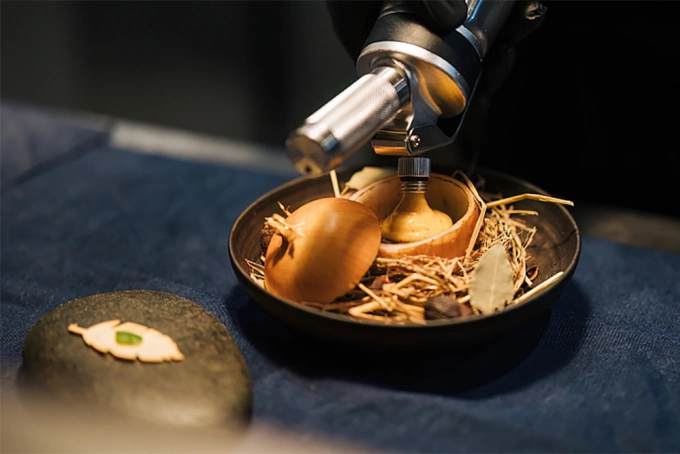
At Oryz Saigon, chef Chris Fong serves his pho satay inside a scooped-out onion. Photo courtesy of Michelin |
In September 2023 Fong opened Oryz at 51 Tran Nhat Duat Street in Tan Dinh Ward. He envisioned it as a space for cultural exchanges rather than just dining.
Within months, in 2024, Oryz earned a spot in the Michelin Guide Vietnam. Among its rotating menu, one dish stood out: pho satay.
While researching for Oryz's menu, Fong stumbled upon a noodle shop in HCMC's Chinatown serving a dish called pho satay, an encounter between Vietnamese pho and Teochew-style satay noodles.
Fong told Michelin Guide: "I kept returning to the shop to taste the dish and talk with the owner about how it was made. The most challenging part was perfecting the satay sauce."
It took him two weeks of trial to perfect the sauce. It is a blend of roasted peanuts, garlic and spices ground into a paste. The texture must be thick enough to hold its flavor in the beef broth, and the ratio of peanuts to spices must be precise. Too many peanuts, and the dish loses balance; too few, and the sauce lacks depth.
He explains that Teochew satay is usually not spicy but mild and more peanut-forward. But the pho satay he found in Chinatown has adapted to Vietnamese tastes, combining bold southern herbs and spices with heat and greater depth.
 |
|
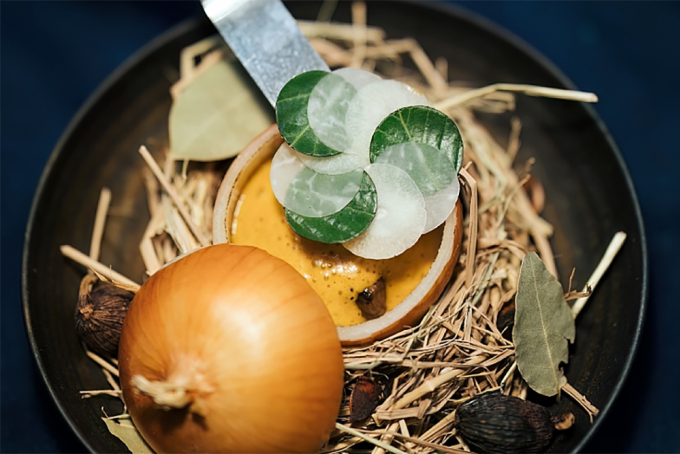
The pho satay at Oryz Saigon is set on a bed of straw and spices, and topped with vegetable slices. Photo courtesy of Michelin |
At Oryz, Fong serves his pho satay inside an onion. Its sweetness enhances both the broth and the sauce, turning the onion into an essential part of the dish.
As Epicure Asia noted, the cooking at Oryz "bridges communities and history through flavor," a philosophy reflected in Fong's approach to pho satay.
The presentation embodies his belief that food can be a form of storytelling.
The onion symbolizes the transition from Teochew noodles to Vietnamese pho. In Chinese and Cantonese cooking, ingredients like daikon or sugarcane are used to sweeten broths.
In contrast, onions are fundamental to pho, providing its depth.
"By serving pho satay in an onion, we highlight this cultural shift, illustrating how the dish evolved through migration and adaptation," Fong adds.


