
The most read Vietnamese newspaper
Edition: International | Vietnamese
© Copyright 1997 VnExpress.net. All rights reserved.
 Get VnExpress first in Google Search
 See more of the news you trust. Make VnExpress a preferred source to prioritise our updates in your Google search results
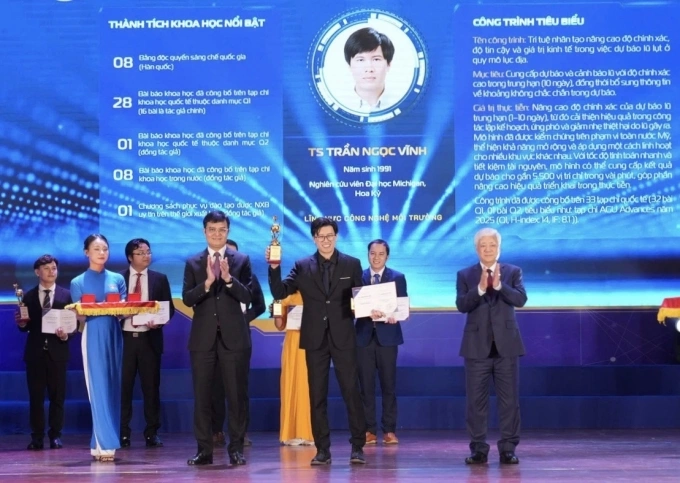
The University of Michigan researcher, a Bac Giang Province native, received in October the award presented annually by the Ho Chi Minh Communist Youth Union and the Ministry of Science and Technology to 10 outstanding young scientists under 35.
Vinh is a co‑inventor on eight South Korean patents, has written dozens of Q1‑journal papers and contributed to specialized hydrology books.
His path began at the University of Science, Vietnam National University, Hanoi. He missed his first‑choice Math–Informatics program in 2009 and was placed in Meteorology, Hydrology, and Oceanography. He stayed, reasoning that a niche field might mean better opportunities.
 |
|
Dr. Tran Ngoc Vinh receives the Golden Globe Science and Technology Awards 2025 in October. Photo courtesy of Vinh |
In his second year, he chose Hydrology over the more crowded Meteorology track. Field surveys in flood‑prone central provinces turned curiosity into commitment: forecasting disasters and reducing losses would define his career.
After graduating in 2014, he joined the university’s Center for Environmental Fluid Dynamics. Three years later, he was awarded a PhD scholarship to the University of Ulsan (South Korea) in civil engineering.
As Vinh notes, in Korea and most countries, hydrology sits inside civil engineering because it underpins construction and sustainable development. The early months abroad were jarring, new language, culture, and lab, but over five years, he settled into a relentless rhythm of 14–15 hours of work a day, fueled by his love of programming and research.
In 2022, Vinh aimed for the United States. He sent nearly 20 applications and received offers from more than ten universities. After weighing rankings, research fit, and quality of life, he chose the University of Michigan, one of America’s leading public institutions.
There, he leads a group in the Department of Civil and Environmental Engineering. His first project as lead, "Artificial Intelligence to Improve the Accuracy, Reliability, and Economic Value of Continental‑Scale Medium‑Range Flood Forecasts", finished in 2023.
The team built a new framework that layers AI onto the U.S. National Water Model (NWM), cutting modeling errors and producing more accurate forecasts.
 |
|
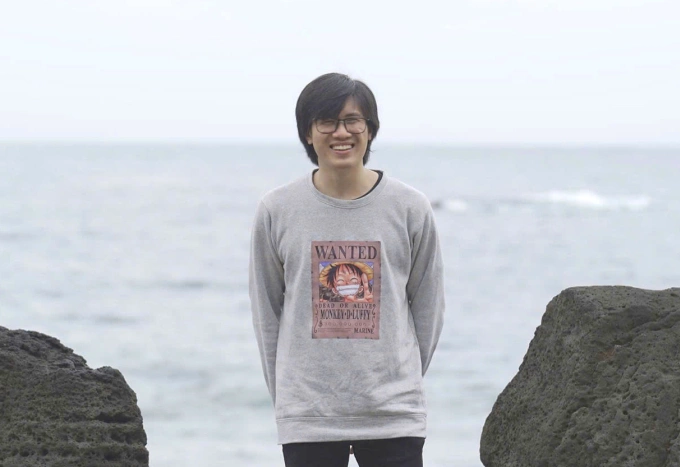
Dr. Tran Ngoc Vinh during a UNESCO water-resources management training program on Jeju Island, South Korea, in 2021. Photo courtesy of Vinh |
As lead author, Vinh handled meteorological inputs (rainfall, temperature, wind), flood‑flow data, and NWM simulations; designed the overall research framework; built simulation scenarios to evaluate performance; and led manuscript drafting and peer‑review responses. He also designed, coded, and trained the AI model, which was tested nationwide on more than 42,000 flood events.
The team’s outputs appeared in 33 international journals, most of them Q1, including AGU Advances, a leading journal of the American Geophysical Union.
Vinh says the model improves medium‑range forecasts (1–10 days), strengthening planning, response, and loss mitigation. With fast, resource‑efficient computation, it can generate forecasts for nearly 5,500 locations within minutes.
Crucially, it provides probabilistic scenarios, key to decisions under high risk, and can run on ordinary computers, no supercomputer required.
Vinh is also proud of a Nature Cities study on urban flooding, which finds that current drainage‑system design is not optimal, helping explain why mitigation often underperforms.
As a 2025 Qua Cau Vang honoree, he hopes to apply these advances in Vietnam: better flood prediction, practical prevention measures, disaster‑resilient infrastructure, and optimized drainage in Hanoi and Ho Chi Minh City.
On Hanoi’s flooding, he urges a fresh look at rainwater management: intentionally collecting and reusing rainwater; re‑distributing flows; and creating many "necks" in the system instead of relying on a few chokepoints.
"Solutions often start with ideas that seem naive," Vinh said. "But I believe they can succeed if pursued to the end, with rigorous data and sound calculations."
Vinh’s current work centers on riverine and urban flood forecasting. After returning to Vietnam to accept the award, he stayed more than a month to connect with scientists and hydrometeorological forecasting projects for potential collaboration. Long-term, he hopes to make a mark on the global research map.
"Right now, the U.S. offers more favorable conditions for research," he said. "However, if one day an opportunity arises in Vietnam with the right conditions, I am ready to return and contribute."
He hopes Vietnam will lower barriers to research, especially around data access. Today, datasets are siloed by agency and not always open to researchers. He also calls for stronger support for basic science, particularly Earth sciences and, within that, meteorology and hydrology, fields that are vital yet underfunded.