
The most read Vietnamese newspaper
Edition: International | Vietnamese
© Copyright 1997 VnExpress.net. All rights reserved.
 Get VnExpress first in Google Search
 See more of the news you trust. Make VnExpress a preferred source to prioritise our updates in your Google search results
She was admitted to the emergency department at Tam Anh General Hospital in Hanoi in a deep coma, lacking reflexes, with a Glasgow Coma Scale score of 6 (a normal person scores 15).
Her left pupil was dilated to 4 mm with no light reflex, while her right pupil was 3 mm with a weak response; she also exhibited paralysis on both sides of her body. A CT scan revealed a large acute hematoma in the left hemisphere (78×59×57 mm).
There was extensive brain edema compressing the left cerebellar tentorium and uncal herniation compressing the brainstem. A subdural hematoma in the left hemisphere measured some 7.5 mm thick.
 |
|
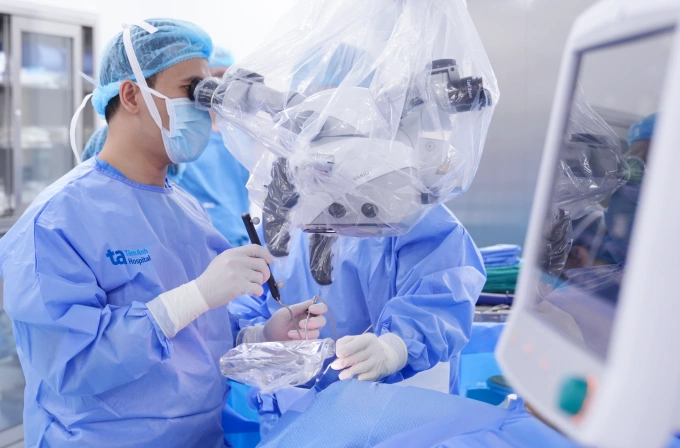
The medical team performs surgery on the patient. Photo courtesy of Tam Anh General Hospital |
The hemorrhage had originated from a ruptured arteriovenous malformation. Dr. Nguyen Duc Anh, head of the hospital's neurosurgery and spine department, said the rupture had caused massive bleeding and pooling of blood within the brain, creating a critical situation.
Doctors indicated microsurgery to perform a craniotomy to fully remove the large hematoma and the malformation, stop the bleeding and preserve maximum neural structure.
The team removed a section of the skull at the corresponding location, used a surgical microscope to dissect the membrane layers and passed through the brain parenchyma to reach the hematoma.
According to Anh, there were multiple challenges because the hematoma was located near the ruptured vessel, creating a risk of secondary bleeding during the surgery. The cerebral edema and increased intracranial pressure caused the brain to swell, making visibility difficult.
Because the lesion was deep, doctors had to operate with extreme precision to preserve healthy brain tissues and minimize sequelae. After four hours of surgery, the team successfully removed the entire hematoma and controlled all bleeding points.
Loan underwent intensive care to reduce brain swelling, mitigate the risk of thrombosis and stabilize her hemodynamics. After one week she was out of critical danger and gradually entered a stable phase, beginning rehabilitation with exercises specifically designed to optimize motor and cognitive function.
After 30 days her health progressed well, and her consciousness improved.
Anh said hemorrhagic strokes often cause more long-term disability than other types of strokes, with patients being at high risk of functional as well as cognitive decline.
They could cause paralysis, permanent disability, a vegetative state, or death if emergency aid is not provided in time, he said.
Cerebral arteriovenous malformations can be congenital or form over time (such as brain aneurysms).
Anh said people with AVMs need to proactively undergo periodic monitoring to assess risks and choose appropriate management directions.
In cases where treatment is indicated, patients should intervene early with suitable methods to prevent dangerous complications like strokes.
Adults should have a general health check-up every six to 12 months to detect abnormalities early and proactively prevent strokes or intervene promptly.
Young people are increasingly suffering from strokes. According to a study published in the journal Frontiers in Neurology (2025), the stroke rate in the 15–39 age group increased to 25.45 cases per 100,000 people in 2021, with 101 countries recording rates higher than the global average.
Anh blamed this on factors like unscientific diets, lack of physical activity and work pressure. Young people could reduce their risk of strokes if they proactively control risk factors early, he said.
They should maintain a healthy lifestyle by balancing food groups, reducing salt and saturated fats and increasing green vegetables, fruits and protein (fish, white meat, eggs), and limiting red meat, he said.
Exercise regularly for at least 150 minutes a week, get enough sleep, limit stress, and manage underlying conditions.
Go to the hospital immediately if there are abnormal signs appear such as facial drooping, weakness in the arms or legs, difficulty speaking, or a sudden severe headache.
*Patient's name has been changed.