





Riverside streets in the old town were flooded by up to 0.5 meters after prolonged rain caused by the remnants of Storm Fengshen.
Photographer Nguyen Xuan Anh from Hoi An said that by the afternoon of Oct. 22, he went out to capture images of the flooded town. Many businesses had shut down and tourist services were temporarily halted, yet the old quarter remained busy with locals and visitors walking through the water.

Shop owners on Bach Dang Street closed and lifted their belongings to higher shelves to prevent damage from rising floodwaters.
According to Xuan Anh, among the three main streets: Tran Phu, Nguyen Thai Hoc and Bach Dang, only Bach Dang suffered severe flooding, with all restaurants and stores along the street suspending operations.

Bach Dang runs low and parallel to the river, making it prone to flooding whenever heavy rains coincide with rising river levels. One restaurant owner said most businesses on the street had proactively closed and cleaned up from the night of Oct. 21 to prepare for inundation.

Meanwhile, a café on Nguyen Thai Hoc Street remained open to customers.
Ann Mala, a tourist from Poland, said she strolled through the old town on the afternoon of Oct. 22 as light rain continued to fall and streets were covered in water. She was impressed by the calm, upbeat spirit of the locals, who "always have a cup of coffee and a smile ready."
"Even in the rain and floods, people sit leisurely on their porches sipping coffee, while children splash around joyfully in the street. I love this place," Ann said.

One visitor on Bach Dang Street was seen wading through the water to sightsee and record the flooded scenes.
The old town only allows pedestrians and bicycles; motorbikes and cars are banned during the restricted hours of 9–11 a.m. and 6–9:30 p.m.
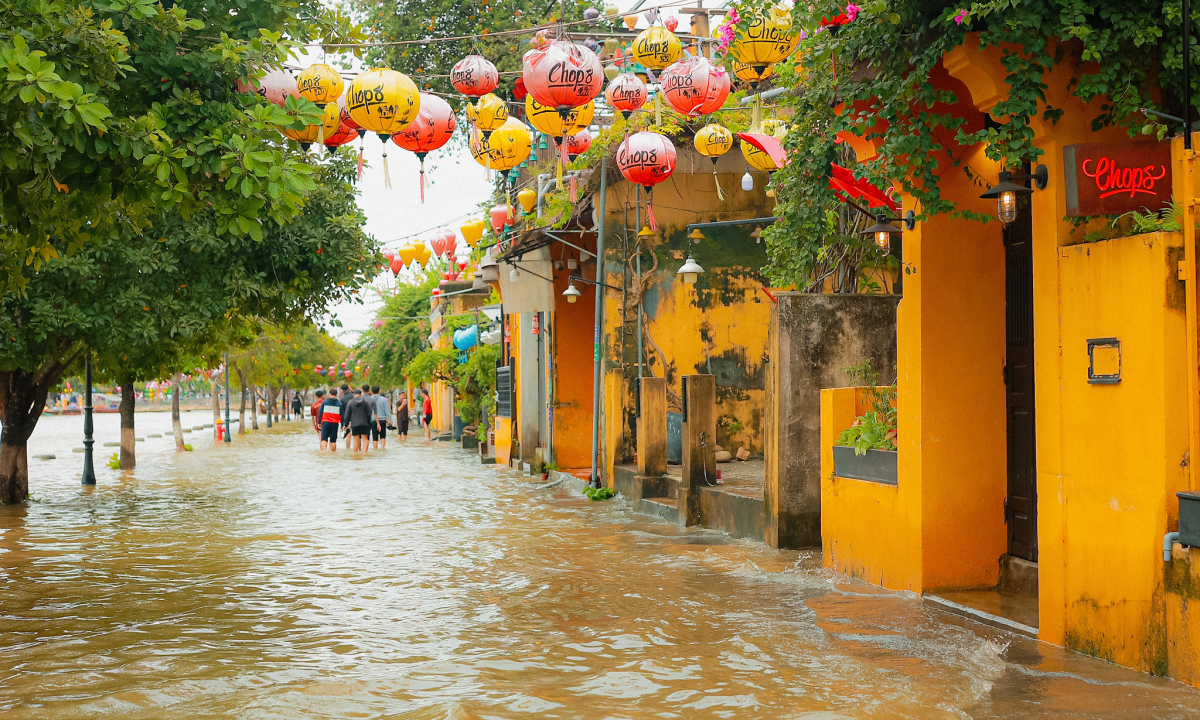
A corner of Phan Chu Trinh Street was also submerged. Local shopkeepers said the number of visitors to the old town remained steady. Toward the end of the year, international tourists make up the majority, visiting evenly throughout the week, unlike the summer months when domestic visitors crowd the weekends.

Several operators of river-tour services on the Hoai River suspended operations due to the heavy rain. By the afternoon of Oct. 22, river levels had risen close to the bridge girders, making it impossible for boats to pass.
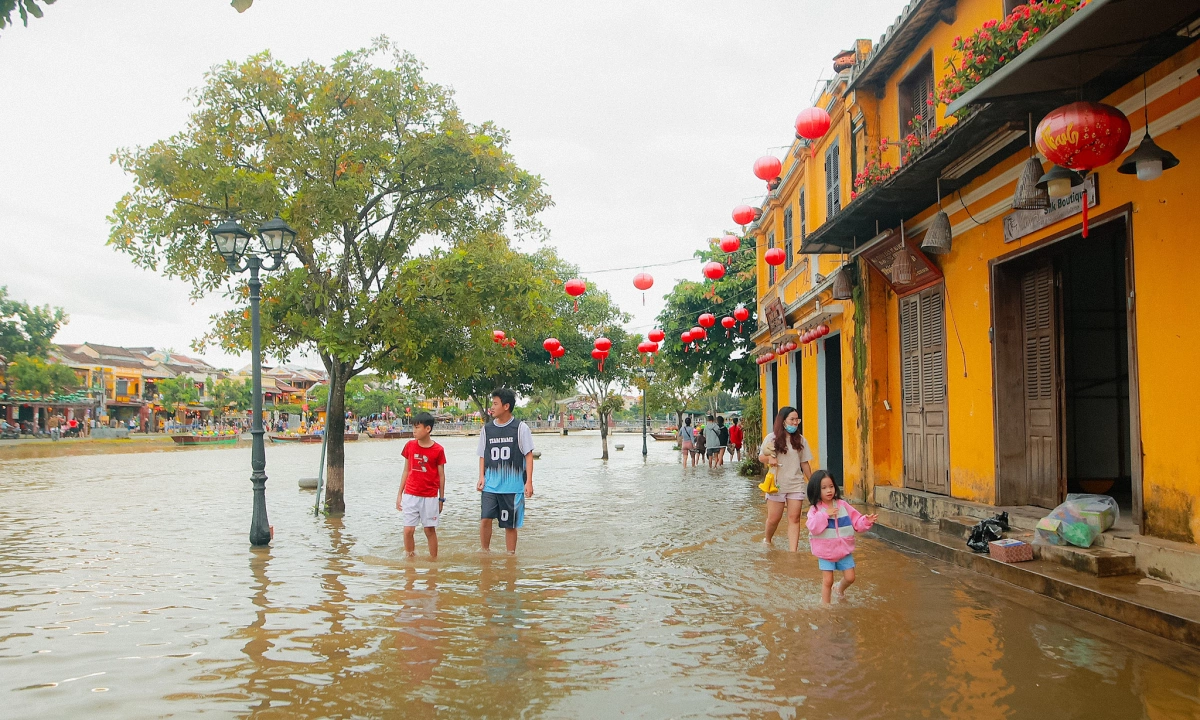
Xuan Anh noted that October is typically the rainy and flood-prone season in Hoi An, with storms and long downpours affecting central Vietnam. Heavy rain in the region is expected to persist through the end of the month.
Meteorological authorities have warned of high risks of flash floods and landslides in mountainous areas, and flooding in low-lying and urban zones.
The tropical depression has already brought heavy rainfall to Ha Tinh–Da Nang, with totals between 7 p.m. on Oct. 21 and 8 a.m. Oct. 22 exceeding 80 mm in many locations: Mac Khe Lake (Ha Tinh) recorded 149 mm, Truong Xuan (Quang Tri) 89 mm, and Bach Ma National Park (Hue) 108 mm.
Forecasters predict that from Oct. 22 to the night of Oct. 23, rainfall will reach 100–200 mm across Ha Tinh–Quang Ngai, with some areas exceeding 300 mm; particularly in southern Quang Tri–Da Nang, rainfall may reach 200–400 mm, locally surpassing 700 mm, with intense bursts over 150 mm within three hours.
Over the next 48–72 hours, rainfall in Ha Tinh–Quang Ngai will gradually decrease to 40–80 mm, though localized areas may still exceed 150 mm. Rain is likely to persist until the end of October, with river levels in southern Quang Tri–Da Nang potentially rising to alert levels 2–3.


