




Hin Nam No National Park lies in Boualapha District, Khammouane Province and is contiguous to Vietnam's Phong Nha - Ke Bang National Park.
The area is one of the world's most intact limestone karst landscapes. Formed some 400 million years ago where the Annamite Range meets the Indochinese Limestone Belt, it contains more than 220 kilometers of caves.
Among them are Son Doong and Xe Bang Fai, two of the largest on earth.
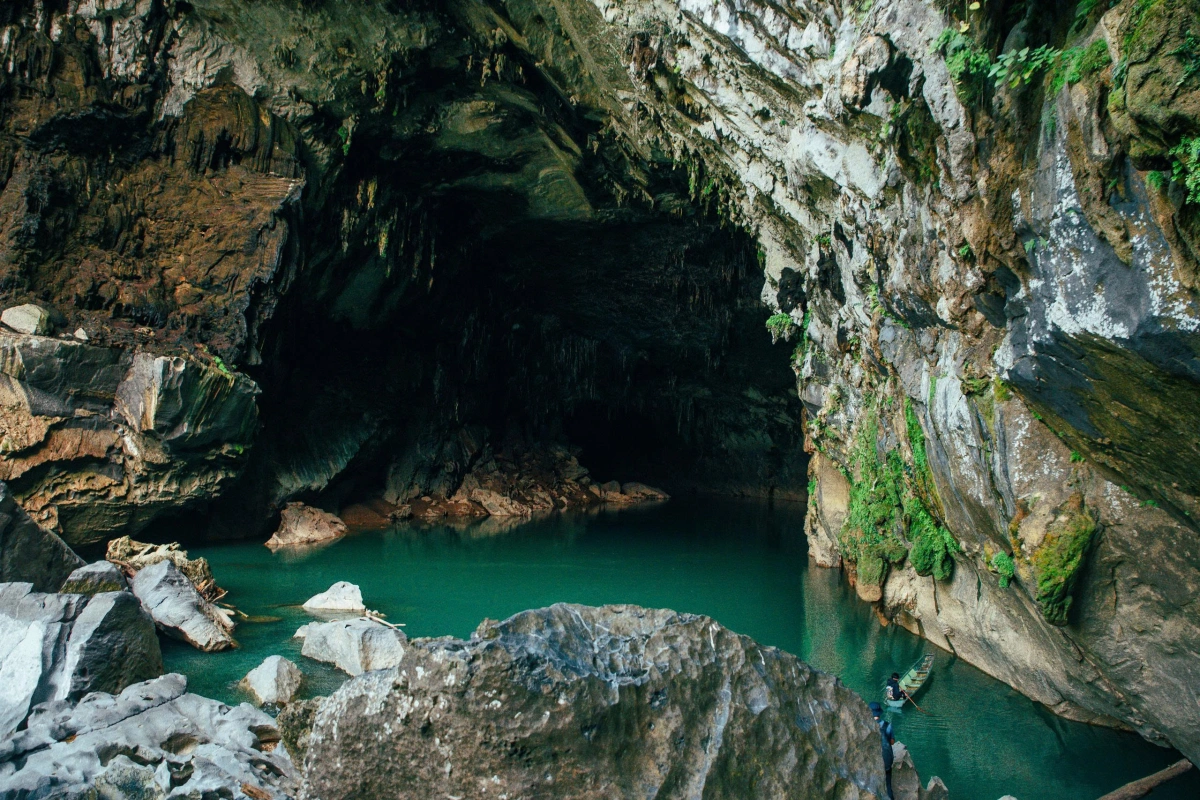
The photo shows the entrance to Xe Bang Fai, known as Tham Khoun Xe, captured by photographer Nguyen Trong Cung during an expedition in late November.

Cung says that while Xe Bang Fai is smaller than Son Doong, it is much easier to access, making it suitable for people who are not yet ready to attempt Son Doong.
"The jade-green river feels very similar to floating down the Son River into Phong Nha Cave."

The cave entrance forms an arch about 60 meters high. On average, the cave is 76 meters wide and 53 meters high, with some sections stretching beyond 100 meters in width.
From the river mouth, a collapsed sinkhole now covered in vegetation, visitors have to go by a seven-kilometer underground river. In places the cave stretches to 120 meters high and 200 meters wide.

Inside the cave are towering stalagmites, underground gardens and fossilized passageways.
Cave pearls are also found here. They are stone-like formations that grow when water drips into gour pools. Over thousands of years, layers of minerals build up around particles, forming round or hexagonal “pearls”.

The widest section of the cave measures 200 meters, with water depths ranging from four to 12 meters. Many stalagmite columns stand 20 meters tall.


Inside, temperatures are about five degrees Celsius cooler than outside. The route includes uneven rocks, moss-covered surfaces and damp sand. Cung advises wearing shoes with a good grip to avoid slipping.

Xe Bang Fai has become popular in the past 15 years. Visitors can bring inflatable boats or hire boats to navigate the underground river.
The Xe Bang Fai River rises in the Annamite Range along the Laos - Vietnam border and flows across the Nakai Plateau before joining the Mekong River.
Nakai Plateau, made up of sandstone and carbonate layers, has been eroded by the river, creating an underground passage about seven kilometers long.

Local people have known about Xe Bang Fai for centuries, but outsiders discovered it only in 1904, when French colonial administrator and explorer Paul Macey led an expedition to the area.
But the cave was then closed to foreign visitors and reopened only in 2005 - 2006, when kayakers and travelers were allowed to return.
Cung says the highlight was paddling through the cave beneath limestone arches on still water, an experience visitors to Laos should not miss.


