




The Metropolitan Area Outer Underground Discharge Channel (MAOUDC), a colossal engineering feat featuring massive underground water storage tanks, was completed after 13 years of construction, successfully reducing flood damage in the region by 90%.
The facility's above-ground headquarters is located in Kasukabe (Saitama Prefecture), north of Tokyo in the photo above.
As one of the world's largest megacities, Tokyo has a long and difficult history with flood control. The capital sits on a low-lying plain surrounded by five major river systems and is intersected by more than 100 rivers of various sizes, making it highly vulnerable to rising waters.
To combat this, the government launched the MAOUDC project in 1992 with a total investment of 230 billion yen (US$2.2 billion). The system became fully operational in 2006, establishing itself as the world's largest underground flood-control facility.

The facility's underground tunnel network diverts floodwater from small and medium-sized rivers in northern Tokyo into five gigantic vertical shafts. Each shaft measures 70 m deep, large enough to contain a Space Shuttle or the Statue of Liberty, as described by AFP.
Once collected, the water is channeled through a 6.3-kilometer tunnel and discharged into the Edo River. This process is powered by high-capacity pumps capable of moving nearly 200 cubic meters of water per second.
In the photo, a MAOUDC staff member looks down from the rim of underground Shaft No. 1.

Inside Shaft No. 1, which plunges 72.1 meters deep, a series of stairways descends to the bottom to facilitate maintenance and inspection work.
When water levels in the Edo River rise, the MAOUDC manages the surge using a massive pressure-regulating tank. This vast subterranean chamber, roughly the length of two football fields, reduces the momentum of the incoming water, allowing the pumps to safely control the flow and discharge it into the river.

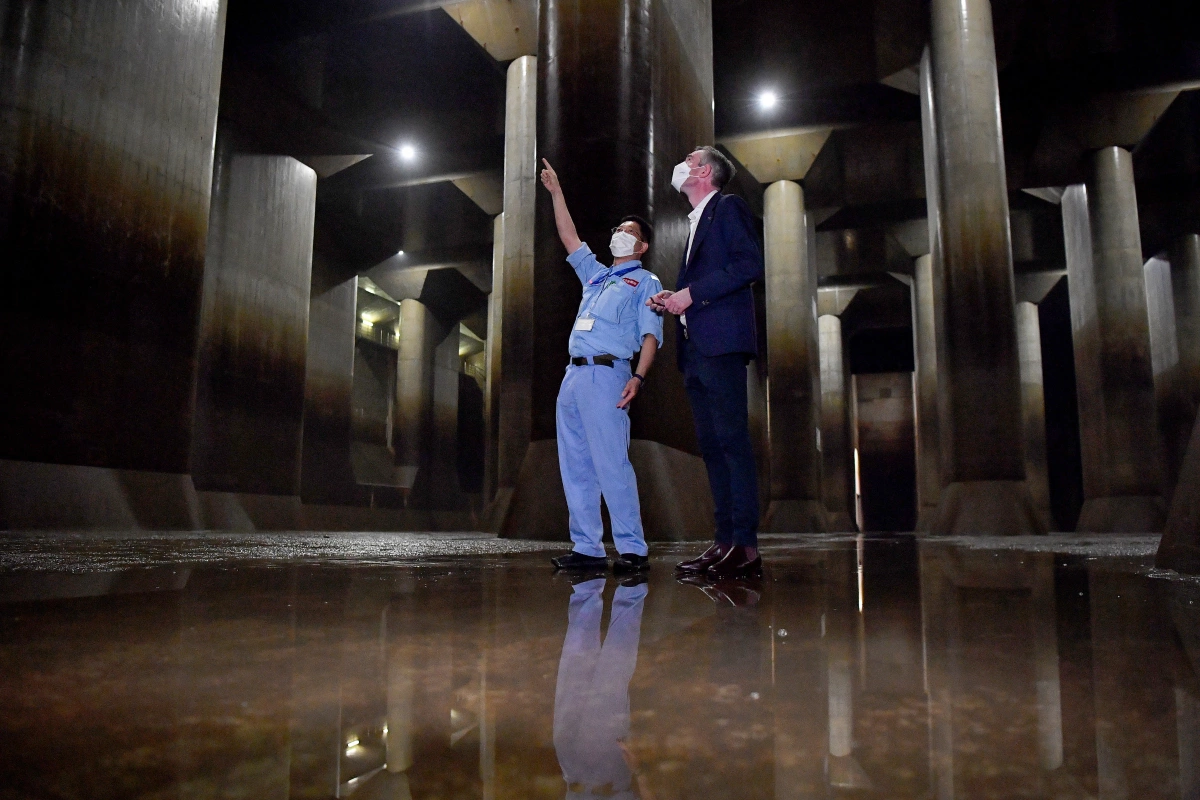
This enormous pressure-regulating tank is famously nicknamed the "Pantheon" due to its resemblance to a majestic Greek temple. The cavernous space is supported by 59 towering concrete columns, each weighing a staggering 500 tons.

MAOUDC staff walk inside the system's pressure-regulating tank. The space can hold a volume of water equivalent to 100 Olympic-size swimming pools.
In a 2018 interview with the BBC regarding the MAOUDC, Miki Inaoka, a disaster management expert at JICA, said: “It feels like a facility from a science-fiction story.”

MAOUDC operates about 7-12 times a year, especially during Japan's rainy and typhoon season from June to late October.
Staff at the facility in Saitama, north of Tokyo, are on constant alert, especially during Japan's rainy and typhoon seasons from June to late October.
"In this area, torrential rain, typhoons and even daily rainfall can cause damage by submerging houses and roads," the site's chief, Nobuyuki Akiyama, told AFP.
The reservoir has helped reduce the number of homes affected by water damage in nearby areas by around 90%, he said.
During Typhoon Shanshan in 2024, the system stored enough water to fill four Tokyo Dome stadiums before safely pumping it into the Edo River and out to sea.

When not in operation, MAOUDC opens to visitors to raise public awareness about the importance of disaster management.


Visitors tour the interior of the MAOUDC pressure-regulating tank.
To date, MAOUDC is part of a broader flood-control network of more than 28 detention basins across Tokyo, with seven more facilities under construction. Once completed, the entire network will be able to handle 100 millimeters of rainfall per hour, more than London typically receives in two months.