





Hanoi has been experiencing days of air pollution ranked among the highest in the world, lasting from morning until night. A thick layer of haze mixed with fine dust makes it easy for residents to notice the declining air quality.
On the morning of Dec. 12, multiple monitoring stations recorded AQI readings above 220, a "very unhealthy" level. This marked the fourth consecutive day the index remained at this threshold, making it the most severe pollution episode of the winter so far in Hanoi.
Photo by Thanh Hai

At 10 a.m. on Dec. 11, the three chimneys of the Van Dien Phosphate Fertilizer Plant on Phan Trong Tue Street, Thanh Tri Commune, continuously released black and white smoke.
Photo by Hoang Giang

Spontaneous trash burning causing pollution in Hanoi. Video by Huy Manh

Smoke from a motorbike on Ring Road No. 3.
Motorbike emissions are currently considered a major source of air pollution in Hanoi, contributing significantly to fine particulate matter (PM) and harmful gases such as CO, NOx and SOx, especially from the large number of aging vehicles still in circulation.
Photo by Thanh Hai

Spontaneous trash burning occurs in many places and is considered one of the factors worsening Hanoi's air pollution.

Smoke from trash fires surrounds apartment buildings and vacant lots, even though these areas have "no dumping" signs and are regularly cleaned by authorities. Still, illegal dumping and burning continue.
Le Thanh Thuy, deputy head of the Environmental Management Division of Hanoi's Department of Agriculture and Environment, said small-scale trash burning may appear insignificant, but in reality it causes severe pollution right inside residential areas.

Residents exercising run past spontaneous trash-burning spots inside an abandoned park on Pham Tu Street.
Thuy, a local resident, said people bring garbage here to burn almost every day, making the air extremely stuffy.

Construction waste is piled chaotically along Tam Trinh Street, a project already behind schedule, and debris is scattered far and wide as vehicles pass.
Dust is also generated from land clearance zones that lack proper shielding.
Hanoi is currently undertaking multiple major clearance projects, such as De La Thanh and National Highway 6, creating a high risk of dust dispersion if not strictly controlled.
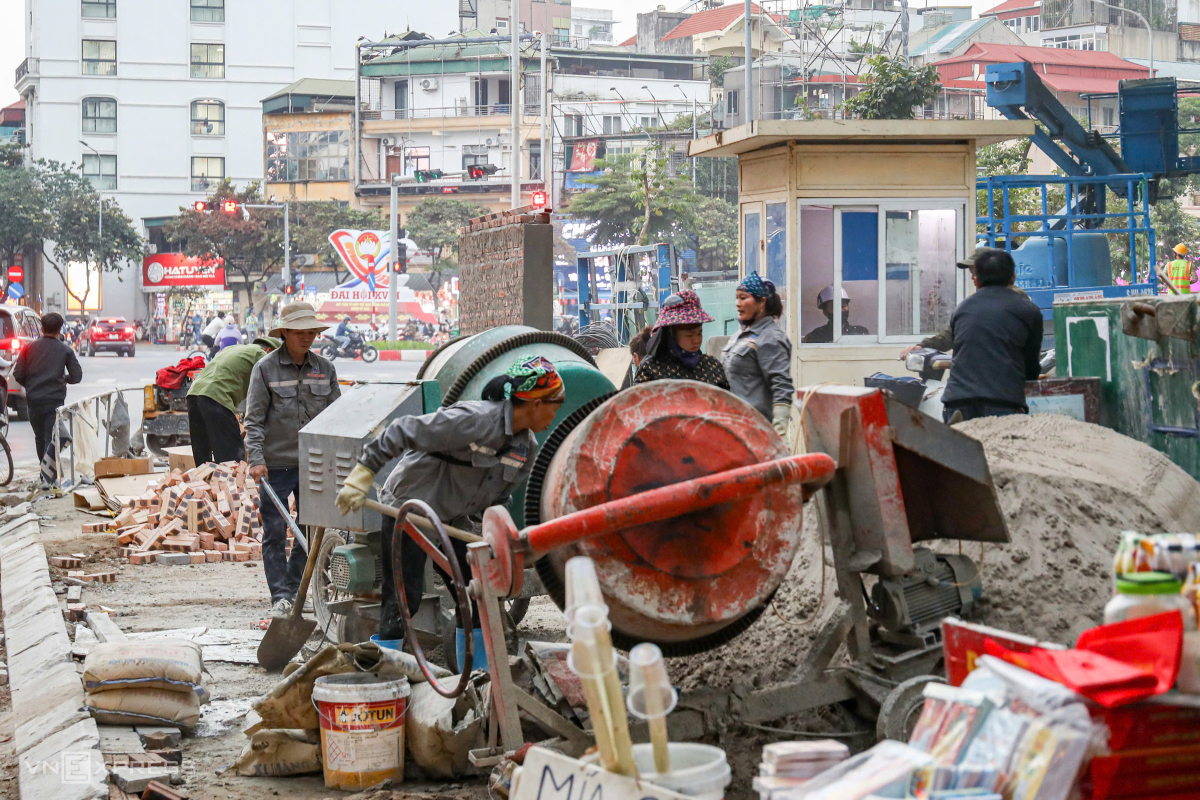
At year's end, Hanoi has intensified sidewalk renovation, sending large amounts of dust into the air.
Many streets have construction sites left uncovered, with almost no dust-mitigation measures. Wind blows dust and construction materials across the surrounding environment.

Air pollution in Hanoi also arises from food-service activities. At lunchtime, many stalls serving the iconic grilled pork noodles bun cha begin fanning charcoal to grill meat, generating thick smoke that spreads directly into the environment.
Hanoi and neighboring provinces have now formed a joint steering committee to identify specific pollution sources across the region and delineate each locality's responsibilities in air-quality control.

A resident transports honeycomb coal briquettes for sale along a street in Cau Giay Ward.
Although Hanoi set a roadmap to completely eliminate honeycomb coal stoves by the end of 2020 and began imposing fines for their use starting in 2021, the production, transport, and sale of this fuel still appear sporadically in the city.
Photo by Thanh Hai


