





The smart factory, inaugurated in February 2024 in Changping District, marks Xiaomi’s shift from a smartphone brand focused on supply-chain optimization to a full-scale manufacturing powerhouse.
Built at a cost of 2.4 billion yuan (US$343 million), it is Xiaomi’s first factory fully owned by the company, designed for large-scale production of flagship models.
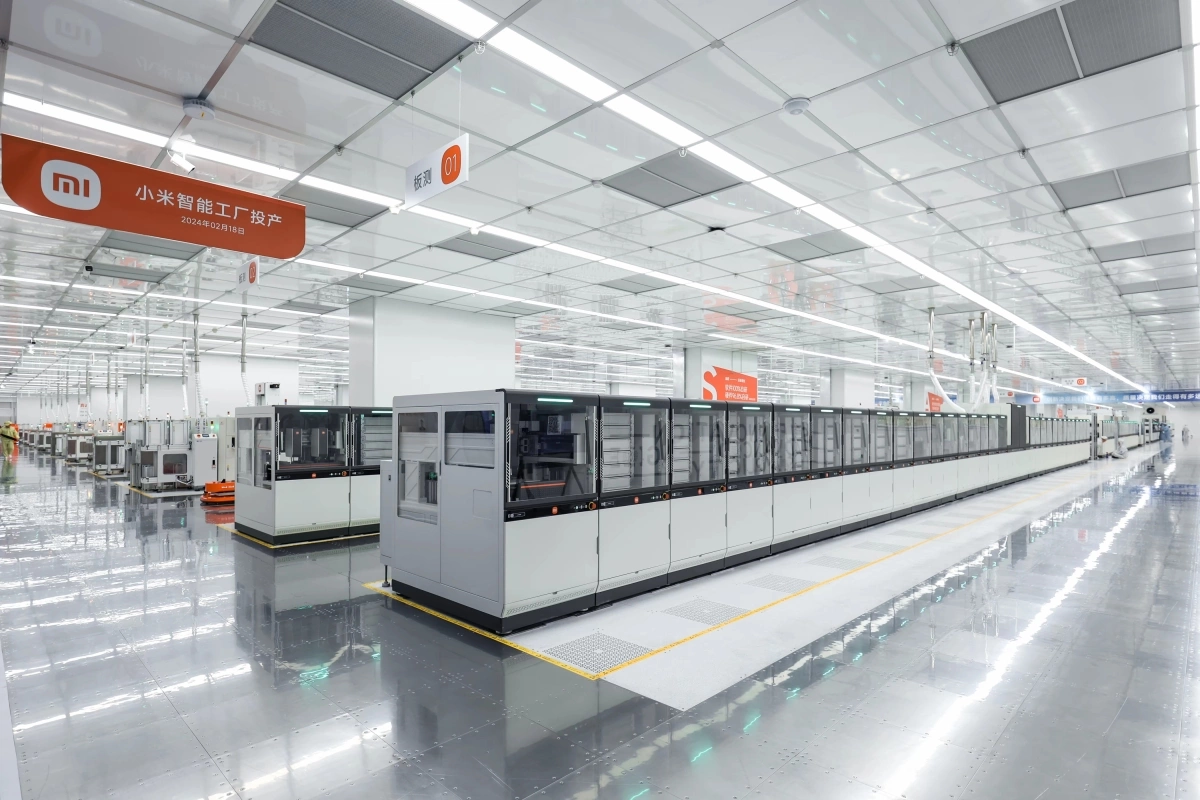
Spanning more than 81,000 square meters, equivalent to about 11 standard football fields, the facility runs 11 production lines around the clock with minimal human presence.
Xiaomi said assembling a smartphone from circuit board to finished product takes about six seconds, and, at full capacity, the factory could produce more than 10 million devices annually.

At the heart of operations is the Xiaomi Hyper Intelligent Manufacturing Platform.
Rather than following fixed instructions, the AI- and IoT-integrated platform is capable of self-monitoring through tens of thousands of sensors collecting real-time data on soldering temperatures, robotic arm pressure and conveyor belt vibrations. The system can instantly adjust parameters. For example, if adhesive viscosity changes due to weather conditions, the AI recalculates pump pressure to maintain bonding quality.
Xiaomi CEO Lei Jun said in an X post that the platform can “identify and solve issues while also helping to improve the production process”, making the factory increasingly intelligent over time.

Xiaomi said a highlight of the facility is its technological self-reliance, with all management software and 96.8% of hardware developed and manufactured in-house. Beyond reducing labor needs, this allows rapid replacement of components and adjustment of assembly parameters to produce different smartphone models.
Minimal human involvement also helps maintain stable production and creates an ultra-clean environment. Advanced filtration and positive-pressure airflow limit fine dust, ensuring precision for tiny smartphone components that are difficult to handle manually.

Xiaomi said smartphone production follows seven stages, starting with surface-mount technology equipment placing microscopic electronic components onto printed circuit boards with micron-level accuracy.
After assembly, robotic arms transfer up to 40 mainboards at a time to testing equipment for multi-channel inspections to verify functionality and performance against specifications.

The boards are then sent to another robot for reinforcement, adding materials such as cushioning layers, steel plates or shock-absorbing pads to enhance structural durability before final assembly.

Throughout production, the Hyper IMP system tracks component inventories and completed batches, while robots transport devices between stages.
Human workers play only a limited role, such as loading components into SMT machines and moving assembled phones to packaging equipment.

After mainboard assembly, robots move the boards to final smartphone assembly in two steps. First, the back cover is attached to the main body of the phone, followed by multiple checks, including water resistance and external appearance.
Devices that pass then undergo final comprehensive testing, including power consumption, antenna performance, audio, camera, display, and sensors, before shipment.

Xiaomi has also developed an Aging Test Chamber to assess durability and stability. The chamber simulates long-term use in different environments to evaluate performance stability and battery lifespan, with each unit capable of testing more than 2,400 phones simultaneously.
Xiaomi said the system shortens testing time and protects workers from prolonged exposure to harsh testing conditions. Devices then move to final packaging before going on sale.


