
The most read Vietnamese newspaper
Edition: International | Vietnamese
© Copyright 1997 VnExpress.net. All rights reserved.
 Get VnExpress first in Google Search
 See more of the news you trust. Make VnExpress a preferred source to prioritise our updates in your Google search results
Each September, when rice terraces in northern Vietnam turn golden, travelers and photographers head to Mu Cang Chai Town to capture the spectacular sight.
Among them was Barbara Landsberg, who came not only to capture the scenery but also to experience local culture.
Her 11-day journey, organized by a tour company, took her to all corners of Lai Chau Province before reaching Mu Cang Chai Town in Lao Cai Province.
"I didn't want this to be just a photo trip. I wanted to tell a story," she said.
After 22 hours of flights and a drive through mountain roads, her fatigue disappeared as the car stopped on a hillside in Lai Chau Province where golden rice fields stretched from valley to peak.
"It was more beautiful than any computer wallpaper - completely alive," she said.
She asked her guide to stop, grabbed her camera, and began shooting. At that moment she felt every effort to reach Vietnam was worth it.
Compared to Australia's farmlands, Vietnam's terraces struck her as a collaboration between human effort and nature. At dawn, when clouds drifted through the valleys, the scene is dreamlike.
"We don't have mountain slopes wrapping around rice fields or floating white clouds like that," she said.
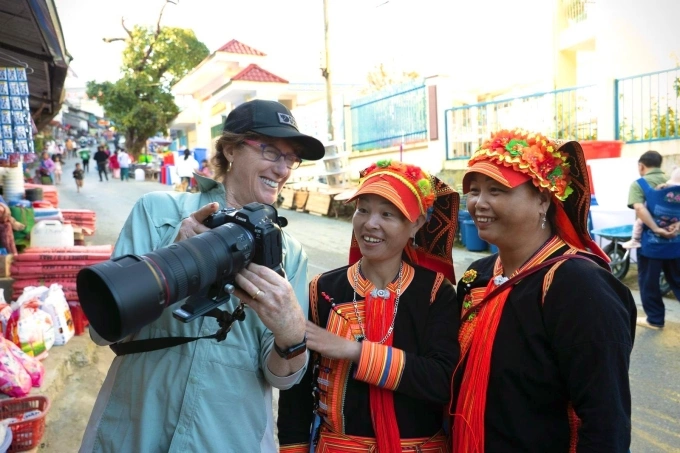
But what stayed with Landsberg most was not the landscape; it was the people. Meeting villagers gave the journey deeper meaning, and reshaped her sense of what it means to live richly.
She recalled a boy tending buffalo in the fields. When the animal grew stubborn, he simply climbed on its back, forming a bond.
"I wasn't sure who was caring for whom, they both seemed content," she said.
At midday she was struck by the rhythm of local life: after a morning in the fields farmers gathered at a nearby house to share a meal together.
The scale of these group lunches and the sense of solidarity surprised her.
As Landsberg kept photographing Mu Cang Chai, she imagined the generations of work that had shaped the terraces on the hillsides.
She said: "Not a single patch is wasted. It speaks of resilience and adaptability."
According to Alex Sheal, co-founder of Vietnam In Focus, which organized Landsberg's trip, more travelers are looking for trips beyond Vietnam's tourism circuit.
"We combine untouched areas, like villages in Phong Tho District, with spots such as Mu Cang Chai. Scheduling weekday departures helps guests avoid crowds and experience local life."
For Landsberg, the journey became a reflection on herself. In Vietnam's rural villages, families live off their harvests and pass down traditions through generations. She saw happiness built on connections and balance.
In contrast, she observed, many people in western cities are caught in financial cycles, bound by 30-year mortgages and work, leaving little time to slow down.
 |
|
Barbara Landsberg shows residents in Lai Chau her photos. Photo courtesy of Barbara Landsberg |
She said: "People here may not have much money, but they're rich in time, family and their connection to nature. It made me wonder what we are really working for."
Landsberg left Vietnam with more than photographs. The trip changed how she views life. To her, Vietnam now represents resilience, harmony and the pursuit of happiness.