
The most read Vietnamese newspaper
Edition: International | Vietnamese
© Copyright 1997 VnExpress.net. All rights reserved.
 Get VnExpress first in Google Search
 See more of the news you trust. Make VnExpress a preferred source to prioritise our updates in your Google search results
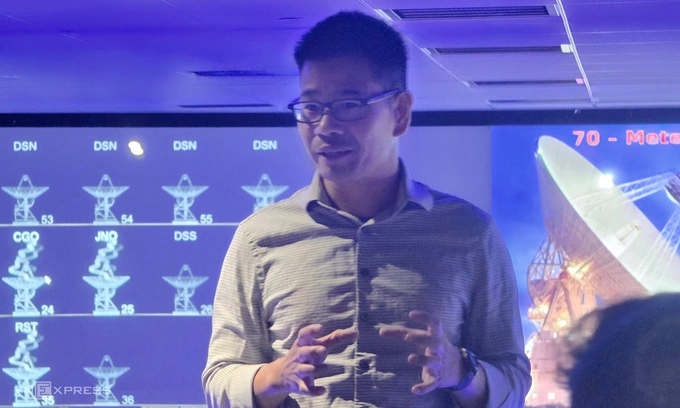
The principal investigator at National Aeronautics and Space Administration's (NASA) Jet Propulsion Laboratory (JPL) in California leads a team developing quantum sensors, a cutting-edge field that harnesses atomic properties and quantum phenomena to measure time, gravity, electromagnetic fields, and other physical variables with extraordinary accuracy.
Today's quantum setups operate almost exclusively inside laboratories, anchored to sprawling optical tables within strictly controlled environments, Thai explains. "The real challenge is figuring out how to move that quantum setup out of the lab."
 |
|
Hoang Thai at NASA's Jet Propulsion Laboratory in California, September 2026. Photo by Luu Quy |
His team's primary goal is to create ultra-precise clocks that are compact and rugged enough to withstand the extreme conditions in outer space.
Pinpointing a spacecraft's position across vast interplanetary expanses currently depends on ground stations beaming radio signals to the vessel and awaiting their return, using the round-trip transit time to calculate distance. Yet as missions venture farther from home, signal lag increasingly limits how reliably this ground-dependent technique can guide them.
Back in 2019, NASA flight-tested the deep space atomic clock, a mercury-ion device built to advance deep-space navigation. Ground-based controlled trials proved it was up to 50 times more stable than the atomic clocks aboard GPS satellites, drifting by just a single second over 10 million years.
Taking an atomic clock from a terrestrial cleanroom to a spacecraft, however, involves far more than simply shrinking its physical casing. Typical quantum systems depend on delicate lasers, vacuum chambers, magnetic shielding, precision optics, and environments where temperature and vibrations are strictly stabilized.
Any space-ready instrument must remain compact, featherweight, and tough enough to survive the violent forces of launch and deep-space extremes, Thai noted. Given the tightly constrained power reserves aboard satellites and deep-space probes, the device must also run on minimal electricity.
Engineers summarize this tri-fold hurdle as SWaP—optimizing size, weight, and power consumption.
For quantum sensors, trimming down all three metrics without sacrificing precision remains the decisive hurdle in bringing the technology into the field.
 |
|
A model of the Perseverance Mars rover on display at NASA's Jet Propulsion Laboratory, September 2026. Photo by Luu Quy |
Thai said his team is pursuing several parallel clock designs. Among them, a microwave clock has been scaled down to roughly the size of a one-liter container, with an eye toward eventually replacing standard clocks aboard future GPS satellites.
Meanwhile, they are also engineering optical clocks, including trapped-ion systems and optical lattice clocks powered by strontium atoms, he said.
"Our long-term goal is to miniaturize optical lattice clocks so that we can send them into deep space to conduct scientific research," he said.
Jason Hyon, who oversees earth science and technology at JPL, said the clocks developed by Thai's team extend far beyond fundamental physics, serving as a linchpin for deep-space positioning and navigation.
"When exploring the lunar surface or a distant planet without GPS, landers and rovers absolutely require ultra-precise onboard clocks."
Bringing quantum technology out of laboratory
The work led by Thai sits within an expansive research ecosystem across JPL, where scientists are uncovering ways to deploy diverse quantum systems across space exploration.
During a media briefing hosted by the US Foreign Press Centers in September, JPL spokesperson said humans have leveraged quantum physics for over a century through everyday technologies like semiconductor transistors, lasers, and atomic clocks.
The field is now experiencing a modern renaissance known as "second-generation quantum," which taps directly into quantum mechanics phenomena such as superposition and quantum entanglement, they said.
"These peculiar properties unlock possibilities for quantum computing, encryption, and measurement sensors that push far beyond the limits of classical physics.
"That is precisely the technological frontier we are pursuing."
Among the projects underway at JPL is a quantum gravity gradiometer. In earlier Earth-observation missions like GRACE, researchers relied on twin satellites flying in tandem to track minute variations in the distance between them as they flew over regions with shifting gravitational pull.
By contrast, JPL's quantum gravity gradiometer uses two ultra-chilled "atomic clouds" suspended inside a vacuum chamber. When passing through gravitational anomalies, each cloud experiences distinct gravitational forces, allowing scientists to map the gravitational field with exceptional precision. Because this technique works without GPS, it opens the door to surveying gravitational fields on distant celestial bodies where satellite navigation constellations do not exist.
 |
|
The operations hub for NASA's worldwide Deep Space Network antenna array at JPL headquarters, September 2026. Photo by Luu Quy |
Quantum sensing remains a pioneer discipline, one that demands prolonged and heavy capital investment in specialized infrastructure, cutting-edge hardware, and world-class talent, Thai said.
Only when capital, infrastructure, and skilled researchers align could these concepts mature into field-ready operational systems, he said. "Pulling all of that together takes considerable time and massive investment. But at the end of the day, I believe people remain the single most critical factor."