
The most read Vietnamese newspaper
Edition: International | Vietnamese
© Copyright 1997 VnExpress.net. All rights reserved.
 Get VnExpress first in Google Search
 See more of the news you trust. Make VnExpress a preferred source to prioritise our updates in your Google search results
Parisi and his collaborators used Claude to solve a longstanding mathematical problem related to the physics of "jamming," according to a study published July 1 in the Journal of Statistical Mechanics: Theory and Experiment.
Jamming describes the point at which a flowing collection of particles suddenly becomes rigid while remaining disordered. Originally used to explain materials such as foams and granular matter, the concept has since found applications in fields including neuroscience and artificial intelligence, according to Physics.org.
In a 2014 study, Parisi, fellow Sapienza University of Rome physicist Francesco Zamponi and their collaborators discovered that two mathematical quantities describing how particles pack together at the jamming point always followed the same relationship. Although repeated calculations confirmed the pattern, the researchers could not explain why, leaving the problem unsolved for more than a decade.
 |
|
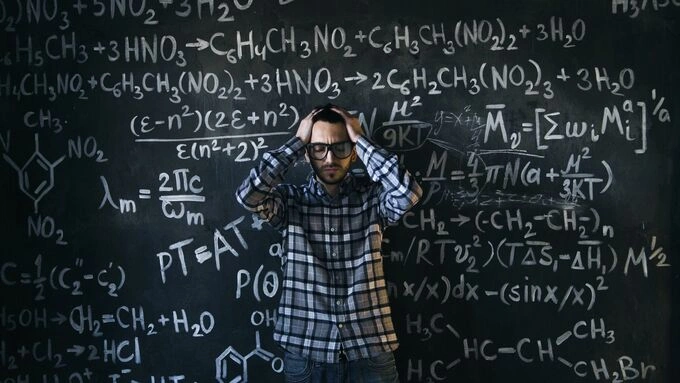
A person struggles with complex mathematical equations on a chalkboard. Illustration from Pexels |
When generative AI models emerged, Parisi chose the unresolved problem as a test of their mathematical reasoning. Zamponi said Claude was selected because it "seemed to have somewhat more advanced mathematical reasoning abilities."
The researchers first asked Claude to reproduce the calculations from their 2014 study. Within about 40 prompts, the AI generated the core idea for a proof that researchers verified and refined into a publishable result. The proof resolved the puzzle and confirmed that two independent theories describe the same underlying physical laws.
"It is entirely possible that a pure mathematician who works full time on such kind[s] of equations might have spotted the solution," Zamponi told Live Science. "But this is a particularly interesting point for us, as it highlights how Claude gave us instant access to a vast repository of mathematical training and formal skills that lay just outside our usual domain."
Zamponi said the experience changed his view of AI's role in theoretical physics. While it prompted him to rethink reasoning, intuition and creativity, he said he plans to continue using AI to speed up routine work and offer fresh perspectives on difficult research problems.




