The most read Vietnamese newspaper
Edition: International | Vietnamese
© Copyright 1997 VnExpress.net. All rights reserved.
When logging into Zalo to reply to customer messages, Thanh Hung, a sales employee in Ho Chi Minh City, saw a screen requesting acceptance of new terms.
Wanting time to read them carefully, he intended to temporarily decline. But a notification that said his "account will be deleted" made him pause. "I was in a rush, and I use this account a lot for work, and so I clicked 'Accept All' to continue using it, even though I hadn't read all the content," he says.
Thanh Tuan in Hanoi, who works in the technology sector and has used Zalo for nearly 10 years, felt a mix of hesitation and concern.
He says he had already accepted terms when he first registered, but the platform now forces acceptance of new terms, which makes him wonder if there are there any hidden clauses that are disadvantageous to users.
When he declined, he was informed that his account would be "deleted in 45 days if he does not change his decision," he says. "I will try other messaging apps. If that doesn't work out, I'll find a way to accept."
 |
|
The terms of use update on the Zalo mobile app, December 2025. Photo by VnExpress/ Luu Quy |
With over 80 million users, Zalo is the most popular messaging platform in Vietnam.
It began updating its terms of service on Dec. 26 with the Zalo user agreement (16 articles) and the Zalo social network user agreement (21 articles). Users can select "agree to all" or enter each service to decline.
Zalo quickly became a topic of discussion in Facebook groups. "I don't object to the terms, but the notification was quite sudden," Thanh Van, an online shop owner, says. "The content is long and dense, and accompanied by a warning the account will be locked; it feels like we are being forced."
She took a screenshot and sent it to friends for advice, and some recommended "agreeing just to get it over with" while others said she should gradually switch to other messaging platforms.
For years Zalo has effected adjustments quietly. For example, in 2024 it added content related to personal data after Decree 13 on Personal Data Protection took effect.
The difference this time lies in several new concepts, clauses and the implementation method. Instead of making changes without fanfare as it used to, Zalo sent a direct notification on the app saying users have to accept to continue using it.
A cybersecurity expert suggested that the move might be related to the Law on Protection of Personal Data that takes effect on Jan. 1.
 |
|
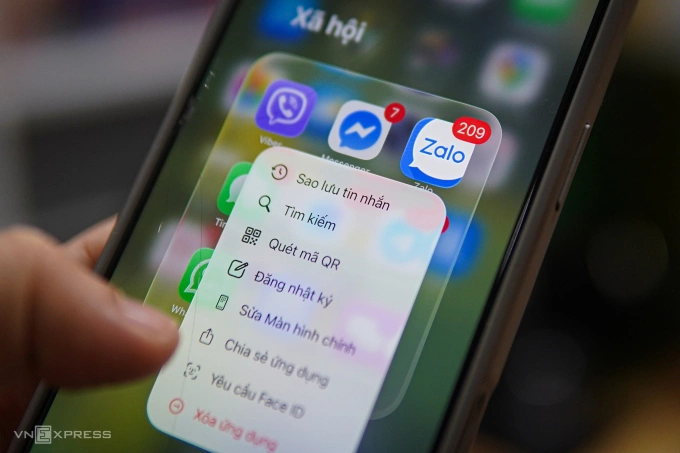
The Zalo app icon on a phone, December 2025. Photo by VnExpress/ Luu Quy |
The law stipulates penalties, with the maximum fine for illegally buying or selling personal data being 10 times the income obtained from it. The maximum fine for organizations violating regulations on cross-border sale of personal data is 5% of their revenues the preceding year.
A Zalo spokesperson did not comment on this matter.
Its support website merely says updating terms "is a common activity for all technology applications and platforms worldwide to ensure compliance with legal regulations and provide clear information to users about changes in the service provision process."
According to Zalo, issuing the notification aims to "ensure transparency regarding activities within the system and protect user rights."
When there are changes to service terms, users would receive information through in-app notifications, it says.
But it also says "users are responsible for regularly reviewing and checking amended content," and describes continued use after amendments as "agreement."
What changed in Zalo's new terms?
One of the notable changes is the distinction between the messaging/calling platform and the Zalo Social Network, rather than referring to them collectively as the "Zalo ecosystem" as before.
According to the introduction, the Zalo social network is provided by VNG Online on Zalo for individuals and organizations to share information.
The Zalo Social Network also adds a definition for "user content," which includes text, images and audio uploaded by users on it.
The terms clearly state that users agree to let VNG Online use, edit, compile, publish, and create derivative works from content users provide or share publicly.
It introduces Zalo ID, defining it as a "technology solution provided by the Zalo platform to establish and enhance security, information safety, manage logins, and ensure seamless user activity on Zalo, wherein Zalo ID is the account used to log in to the service.
"After the user confirms agreement and we complete the Zalo ID integration, the user understands that they can only use the Zalo ID account to use the service."
Regarding data collection and processing, Zalo states this is "to serve other purposes related to Zalo's business operations that we deem appropriate from time to time."