
The most read Vietnamese newspaper
Edition: International | Vietnamese
© Copyright 1997 VnExpress.net. All rights reserved.
 Get VnExpress first in Google Search
 See more of the news you trust. Make VnExpress a preferred source to prioritise our updates in your Google search results
The Seoul Central District Prosecutors’ Office announced on Dec. 23 the indictment of five individuals, including former Samsung Electronics employees, under detention for violating the Unfair Competition Prevention and Trade Secret Protection Act and the Act on Prevention of Divulgence and Protection of Industrial Technology. Another group of five former researchers was indicted without detention on similar charges, the Korea JoongAng Daily reported.
The investigation, initiated in January 2024, followed the discovery that Samsung Electronics’ core semiconductor technology, which was developed after five years of research and an investment of 1.6 trillion won ($1.08 billion), had been smuggled to China since 2016, after a suspect left the company and began working for Changxin Memory (CXMT), a Chinese semiconductor firm.
 |
|
A Samsung Electronics logo and a computer motherboard appear in this illustration taken Aug. 25, 2025. Photo by Reuters |
According to Chosun Biz, the suspect, identified as A, a researcher in Samsung Electronics' DRAM development department, manually transcribed approximately 600 steps of DRAM manufacturing processes and equipment details, believing that copying files or photographing them would be easily detected.
The document, known as the "Process Recipe Plan," contains critical information about the equipment and parameters to be input into systems, and is regarded as the "core of the core" of Samsung Electronics' semiconductor production. A copied each line into a notebook provided by Samsung Electronics to avoid suspicion from the company’s security department. After some time, A handed the notebook to B, a former Samsung Electronics Director General who became the head of development at CXMT.
CXMT, China’s first and only DRAM semiconductor company, was established in 2016 with investments from local governments and semiconductor design firms. Prosecutors stated that CXMT’s cleanroom technicians also illegally obtained DRAM process technology from SK hynix, another state-designated core technology, via a subcontractor in June 2020.
Armed with key technologies from both Samsung Electronics and SK hynix, CXMT successfully mass-produced 10-nanometer-class DRAM only seven years after its founding. A comparison of CXMT materials with Samsung Electronics materials showed a 98.2% match.
Prosecutors believe Samsung Electronics' estimated revenue loss due to the leak amounts to 5 trillion won in 2024.
"Considering the scale of the domestic semiconductor industry — which accounts for 20.8 percent of total exports — the damage to the national economy is expected to reach at least tens of trillions of won," the prosecution said, as quotes by Korea JoongAng Daily.
 |
|
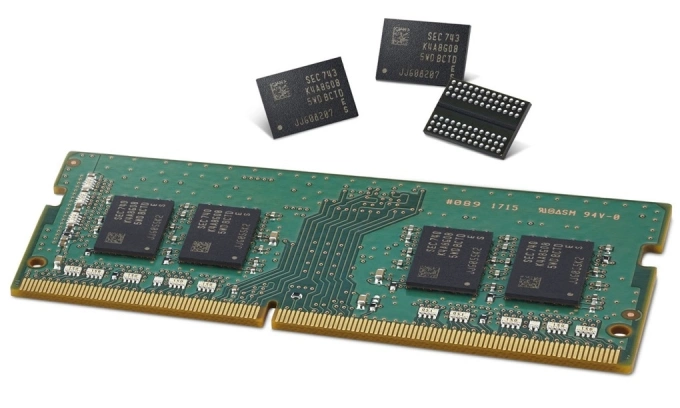
A DDR4 RAM uses Samsung's 10nm memory chip. Photo courtesy of Samsung |
Prosecutors identified A as the person who transcribed and leaked the process technology through handwriting analysis. A was responsible for recruiting engineers at CXMT, targeting those who had faced issues at Samsung Electronics or retired experts who had switched to teaching. Before joining CXMT, suspect B allegedly evaded Samsung Electronics' non-compete clauses and the South Korean National Intelligence Service oversight by pretending to work for a Chinese fertilizer plant.
A and B set up several front companies, frequently moved offices, and established internal guidelines such as "always act as if the National Intelligence Service is around you." They even had their own code of conduct, including sending four heart-shaped icons to alert colleagues in emergencies, such as being banned from leaving the country or being arrested, investigation found.
After arriving in China, the suspects traveled through another city instead of heading directly to CXMT’s location. They used WeChat to message and emailed via Baidu.
A has been in China for nearly 10 years. The Korean government has invalidated A's passport, but it is reported that the Chinese government has extended A's visa despite being aware of the Interpol red notice. Chinese officials and CXMT have not commented on the matter.