
The most read Vietnamese newspaper
Edition: International | Vietnamese
© Copyright 1997 VnExpress.net. All rights reserved.
Bhutan is a small kingdom on the southern slopes of the Himalayas, situated between India and China, and deeply influenced by Vajrayana Buddhism.
Among its traditions is the Drukpa Kagyu lineage, which has forged the country's history, authority and culture for centuries, from its name to its national symbols.
Bhutan's local name is Druk Yul (Land of the Thunder Dragon), and its king bears the title Druk Gyalpo (Dragon King).
The national flag features a dragon along a diagonal line dividing the flag into yellow and orange halves, with yellow symbolizing the king and orange representing the spiritual tradition and the flourishing of Buddhism in general.
Origins of Drukpa Lineage
The Drukpa Lineage traces its origins back 1,000 years to India, beginning with the great Mahasiddha Naropa (1016–1100), known as the "Northern Gate Protector" of the ancient Nalanda University.
It is a branch of the Kagyu (oral transmission) tradition in Himalayan Vajrayana Buddhism, with a lineage transmitted from Vajradhara Buddha to renowned Mahasiddhas Tilopa, Naropa, Marpa, Milarepa, Gampopa.
After Gampopa, the Kagyu tradition divided into several branches.
The Lingre branch, founded by the Mahasiddha Lingchen Repa, became the direct predecessor of the first Drukpa master, Drogon Tsangpa Gyare Yeshe Dorje.
In the late 12th century Tsangpa Gyare, a principal disciple of Lingchen Repa, traveled in search of a sacred site to establish the Namdruk Monastery. He arrived in Nam-gyi Phu, not far from Lhasa, Tibet.
Legend has it that he witnessed nine sacred dragons rising from the earth amid thunderous sounds, leading him to found the Drukpa lineage (Druk meaning "dragon").
 |
|
His Holiness Trulku Jigme Chhoeda (C), the 70th and current Je Khenpo (Chief Abbot) of Bhutan, is with His Eminence Thuksey Rinpoche (L) and His Eminence Gyalwa Dokhampa at the Global Peace Prayer Festival in Thimphu, Bhutan in November 2025. Photo courtesy of Drukpa |
Over the next five centuries the Drukpa Lineage, led by successive reincarnations of Tsangpa Gyare, grew across the Himalayan region.
Its influence became extensive enough for a local saying to be widely quoted:
"Half the people are disciples of the Drukpa Lineage,
Half of the Drukpa disciples are yogis,
Half of the yogis are Mahasiddhas."
In the early 17th century Zhabdrung Ngawang Namgyal, the reincarnation of the fourth Drukpa spiritual leader, the omniscient Kunkhyen Pema Karpo, spread the Drukpa Lineage, unified local communities and laid the foundation for the modern Bhutanese state.
Zhabdrung established the "dual system" (Chosi Nyiden), consisting of a religious pillar led by the Je Khenpo (Chief Abbot) and a secular pillar led by the Desi (temporal ruler), while he himself stood as the supreme symbol of the nation.
The national monastic system largely belongs to the Drukpa Lineage and is state-supported. The Je Khenpo, head of the religious pillar, is appointed by the king. This structure remained the country's distinctive political foundation for centuries.
National rituals, festivals, architecture, and traditional dress all bear the imprint of the Drukpa influence.
From absolute monarchy to constitutional monarchy
In 1907 Bhutan transitioned to a secular monarchy under the Wangchuck dynasty.
Political power became increasingly centralized, gradually replacing the dual system, though the central role of the Drukpa Lineage was maintained.
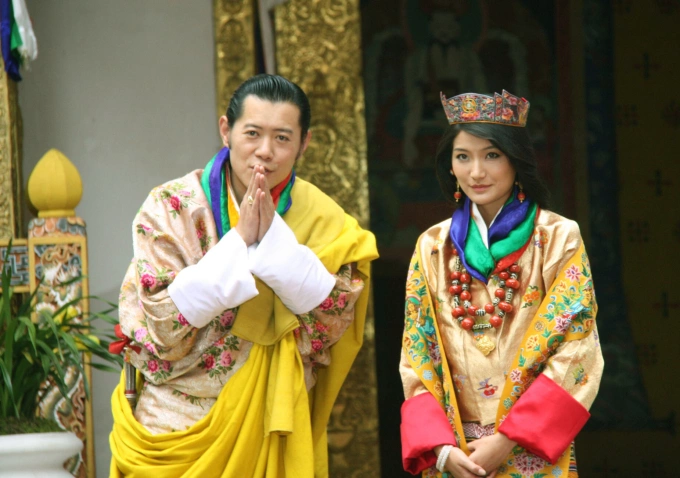
The current king, Jigme Khesar Namgyel Wangchuck, has reigned since 2006. He serves not only as head of state but is also regarded as the current protector of the Drukpa Lineage.
 |
|
King Jigme Khesar Namgyel Wangchuck and Queen Jetsun Pema in Punakha, western Bhutan, October 2011. Photo by Reuters |
In 2008 Bhutan transitioned to a constitutional monarchy and held its first general election.
Although the Constitution does not designate an official state religion, it recognizes the special position of Vajrayana Buddhism in politics and society.
The king continues to serve as patron of religion, while the monastic system remains a moral and cultural pillar of Bhutanese society.
Educated at Oxford University in Britain and the National Defense Academy of India, the king possesses a foundation and skills that enable him to communicate effectively with younger generations.
During public events such as National Day, thousands gather to hear him speak, expressing admiration through songs.
For this reason, King Jigme Khesar Namgyel Wangchuck is often called the "People's King," a title reflecting his close relationship with the people.
He is on record as saying: "Throughout my reign, I will not rule my people as a king. I will protect my people as a father, care for them as a brother and serve them as a son."
This spirit is reflected in his vision for the Gelephu Mindfulness City, announced in December 2023, a special administrative region that is expected to serve as a catalyst for administrative reform and economic growth.
 |
|
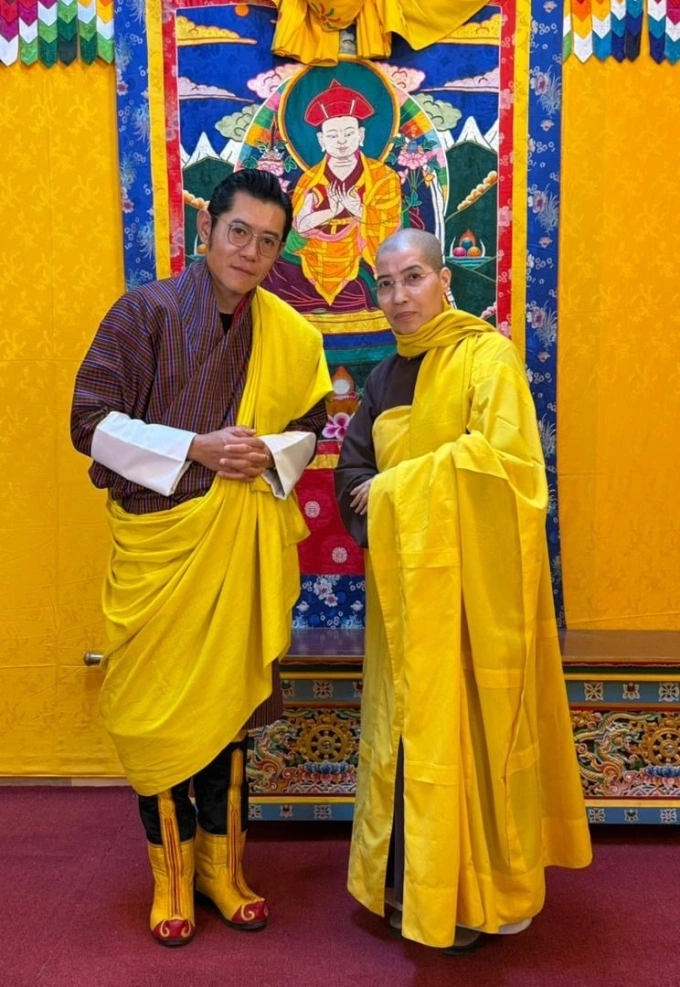
The King of Bhutan with the Abbess of the Mandala Tay Thien Great Stupa at the Global Peace Prayer Festival in Thimphu, Bhutan in November 2025. Photo provided |
Under the project Bhutan plans to build a new, larger international airport with a longer runway capable of accommodating large aircraft flying on long-haul routes.
During the National Day ceremony on Dec. 17, 2025, King Wangchuck announced the allocation of 10,000 BTC (Bitcoin), now valued at around US$650 million, for investment in the project.
"I must ensure that every Bhutanese citizen is a guardian, a shareholder, and a beneficiary of the Gelephu Mindfulness City," the king stated.
Bhutan is well known for its Gross National Happiness index, which combines Buddhist philosophy with public policy to emphasize balance between material well-being, spirituality, environment, and culture rather than prioritize economic growth at all costs.
The Drukpa Lineage provides the philosophical foundation for this model, enabling people to embrace development oriented toward happiness and well-being rather than solely GDP.
This means Bhutan can keep close ties between religion and state despite integrating into an international order.
International influence of the Drukpa Lineage
With a 1,000-year heritage the Drukpa Lineage holds a distinctive place in Buddhist history. More than 80% of the population of Ladakh, an Indian centrally-governed territory, are its disciples.
It also exerts a broad influence across the Himalayan region, including in Nepal and several northern Indian areas.
In the 21st century the Drukpa Lineage has expanded beyond the Indian Himalayas and is now present in many countries, including in the west.
The current spiritual leader, His Holiness the Gyalwang Drukpa, is influential not only religiously but also in intercultural and social dialogue, with internationally recognized contributions.
Born in 1963 into a renowned family of Vajrayana practitioners in India, he has spent more than 50 years teaching Buddhism worldwide.
He has initiated humanitarian projects and promoted volunteer groups focused on environmental protection, disaster relief, education, healthcare, and heritage conservation.
People gather at the Dharma Assembly Program at Tay Thien Mandala Great Stupa in Vietnam's nothern province of Vinh Phuc on Feb. 7, 2025. Video by VnExpress
He has visited Vietnam 12 times, most recently in 2025, to take part in activities for praying for peace and prosperity and for cultural and religious exchanges, including a three-day Dharma ceremony at the Mandala Stupa in Dai Dinh Commune, Tam Dao, Vinh Phuc Province, around 80 km from Hanoi.
The Mandala Stupa is situated near the Tay Thien Special National Relic Site. The 37-meter structure is in the architectural style of Himalayan Vajrayana's great stupas.