
The most read Vietnamese newspaper
Edition: International | Vietnamese
© Copyright 1997 VnExpress.net. All rights reserved.
Scriptwriter Chu Lai focuses on the lives of a squad of soldiers from different regions. The main character, Cuong, a martial arts-trained conservatory student, gives up the opportunity to study abroad to enlist. Under the leadership of Ta, he and his squadmates, Binh, Tu, Hai, and Sen, battle side by side, overcoming their different backgrounds and personalities.
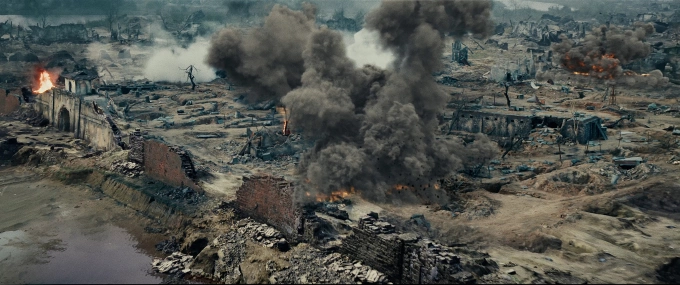
Produced on a large scale, the film was shot on a 50-hectare set built along the Thach Han River in Quang Tri. The production employed advanced equipment, including up to seven cameras for major battle scenes.
As "Mua Do" becomes the highest-grossing film in Vietnamese box office history, with collections topping VND552 billion ($22.3 million), Huyen shares her thoughts and memories from behind the scenes.
- How have you felt these past few days as you became the first woman director to hit the VND500 billion milestone in Vietnam and ‘Mua Do’ broke all sorts of records?
- I believe everyone at the Vietnam People’s Army Cinema (the film's producer) and the film crew is very happy. I am a soldier serving in a film unit under the armed forces. "Mua Do" was a political mission assigned to the Vietnam People’s Army Cinema, so we did not focus on box office numbers.
What mattered most to us was the audience. [It has attracted] more than 7 million viewers, which we see as the greatest reward. This success comes from the effort of the entire team.
Over three years of working on the movie, we treated it like a campaign and a battle. Every crew member worked like a soldier determined to accomplish the mission.
On a personal level, I know many well-known directors were considered to lead "Mua Do". Choosing a female director for such a large-scale war film naturally raised doubts.
But in the end I was trusted and supported by my superiors. I am happy that I did not let down the faith placed in me.
- What do you think helped the film grow beyond the label of a ‘state-funded movie’ to become a success in the market?
- I do not think the issue is whether a film is produced by the state or a private studio, but whether it receives proper investment. A successful film needs three key elements: a strong script, solid production and a committed, hardworking crew. With those in place, I believe a movie, whether made for commercial goals or a political mission, can still connect with audiences.
"Mua Do" has made a small statement about the place of war and revolutionary films. It shows that this genre deserves a space in modern Vietnamese cinema. I hope its success encourages other filmmakers, producers and investors who want to explore the theme.
I do not think it is fair to compare "Mua Do" with other high-grossing films. Every genre has its own purpose, and each film’s success contributes to the overall growth of Vietnamese cinema.
 |
|
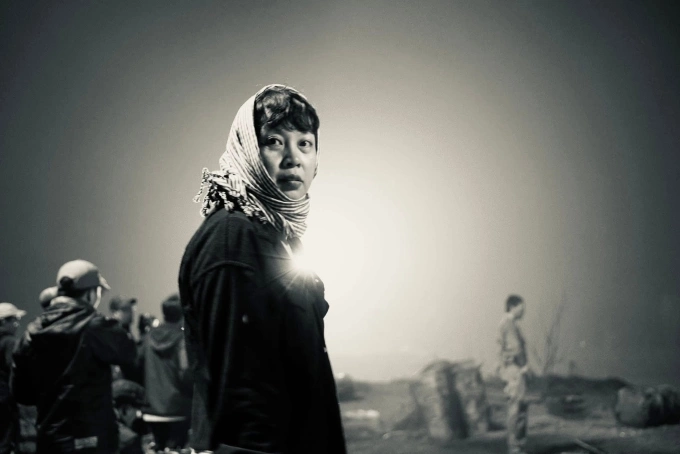
Director Dang Thai Huyen, on the sets of "Mua Do". Photo courtesy of Dang Thai Huyen |
- Of the more than a year of pre-production, 81 days of filming and six months of editing, which stage did you find the most challenging?
- About 90% of the film was shot outdoors, at the very location where the Second Battle of Quang Tri took place during the Vietnam War (Quang Tri Citadel, Central Vietnam). We were hit by waves of emotion when we stepped onto the set. It felt as if the past and present had merged and we were transported back to 1972.
That atmosphere inspired and made everyone more focused on every shot. However, the weather in Quang Tri Province at the time of shooting was freezing and harsh. There were nights when we filmed straight through until morning, and everyone struggled with health issues.
I once fainted in the hotel and was shocked when I came to. I pushed myself to keep going and hid my health problems from the crew. Almost every filming day was intense with large-scale battle scenes that required complete focus from everyone. If I had faltered, it would have affected everyone’s morale. On the sets, I stayed strong and only wound down when I returned to my room.
Post-production was a mental strain and challenge to edit the best possible version of the film. We were also under huge time pressure. After filming wrapped up before the Lunar New Year holidays, I took only a few days off before diving back into work.
By the time the film was complete, from sound and visual effects to color grading, we only had 10 days left before the premiere. My eyes were blurry and my ears were ringing from the nonstop explosions on set. It was physically and mentally draining. I felt like a silkworm sacrificing everything to spin its last thread after finishing "Mua Do".
- The film also touches on national reconciliation through the story of two male leads on opposite sides of the battlefield. What were your thoughts on introducing this topic to a Vietnamese film?
- Some viewers felt there was a stark contrast the revolutionary soldiers and their opponents, from their numbers and weapons to their physical appearance. The "Mua Do" team tried to take a neutral perspective by portraying both sides in the same light. In fact, our victory feels even more meaningful when the enemy was stronger and we still managed to overcome them.
Ly Thai Dung, the film’s director of photography, said ‘Forgetting a war means we risk repeating it in future. But if we cannot forget, we will live in hatred forever.’ This was a constant point of discussion during production.
I believe "Mua Do" offers a respectful and humane view of what should be remembered and what should be let go.
In peacetime, we should work to leave the past behind us and embrace reconciliation. Vietnam’s growth depends in part on uniting all regions and communities. This film is a small contribution to that message, and we will continue to explore it in future projects.
- You said you cried when you read the script for the first time more than 10 years ago. What affected you the most?
- The original script by the author was intense and my heart ached after reading it. It described the soldiers’ deaths as both heroic and deeply tragic.
The scene that stayed with me most was of a soldier sinking slowly into the river. ‘Mother!’ he calls out before disappearing beneath the water.
However, I could not adapt everything from the script to the screen. I wanted the film to reach a wide audience, especially young viewers. If I had kept all the original details, even adults might not have been able to handle it, let alone teenagers. I did not want to leave them mentally exhausted from a two-hour movie. That is not my style of making war films.
To me, a movie should transcend its script. The power of a war film does not come from just its large-scale battle scenes. I also focused on quieter moments and the haunting silences on the battlefield. Sometimes these scenes were harder to shoot than the combat sequences. I think that is my style as a filmmaker. I am grateful to director of photography Ly Thai Dung and production designer Vu Viet Hung for understanding my vision and helping create scenes that capture this spirit.
 |
|
A section of the "Mua Do" set in Quang Tri Citadel. Photo courtesy of the production team |
- When a film is inspired by real history, there are always reactions and concerns about accuracy. How did you approach incorporating historical details?
- We received both praise and criticism, all of which we welcomed. The team and I appreciate the feedback because it helps us improve for future projects.
For example, many veterans told us the film only showed a fraction of what they experienced in the war, and it was not anything as brutal as reality. During filming, we studied historical materials and listened to accounts from war correspondents and eyewitnesses.
But we knew from the start that "Mua Do" was a feature film with fictional elements. What matters is that it inspires viewers, and provides them with a glimpse of the war and its history. We hope it motivates them to learn more about the 81-day battle in Quang Tri Citadel and related events.
After "Mua Do" premiered, we held a special screening at the historic Quang Tri Citadel. The local heritage site management board told us visitor numbers had skyrocketed. Sales of the original novel also rose. I believe the film has achieved its mission of inspiring gratitude and pride.
- Some viewers felt the two women characters at the Paris Peace Accords negotiation were not convincing portrayals of former Vice President Nguyen Thi Binh. What is your response?
- Madam Nguyen Thi Binh is my idol. Her diplomatic presence and charisma are unique, and no one can capture that essence perfectly. Many viewers said actresses Thuy Ha and Yen Nhi did not fully embody her and suggested others might have been more suitable. But none of the characters in the film directly represent Madam Binh.
The actresses’ costumes and appearances were inspired by Madam Binh, but the characters are fictional. That is why we chose to have two women at the negotiation table instead of one as happened in real life. This was not meant to send a specific message but to highlight the push and pull between the battlefront and the diplomatic front.
- For a project as big as "Mua Do", why did you cast mostly new and young actors?
- We held casting sessions in both northern and southern Vietnam. Like my previous projects, I avoided choosing established stars. I wanted fresh faces who would feel authentic to viewers. I believe young, lesser-known actors bring a sense of realism that helps audiences believe in their performances. Viewers can see Binh, Ta and Sen as if they have stepped out of the past and come to life. I’m pleased with how the cast gave their all in every scene.
Before filming began, the cast spent six months studying the script. They lived in a military camp in Cu Chi District (in HCMC). They trained like real soldiers under martial arts and combat instructors. During this time the assistant director pushed them to memorize the script and practice their lines together.
As the set was being built, they familiarized themselves with the environment and spent 15 days shooting key scenes in advance. After half a year they were ready to perform like real soldiers. It was a long, meticulous and costly preparation process.
- Which scene did you think at first was impossible to film but the crew managed to pull off?
- The large river battle scenes. Ly Thai Dung and I agreed that even major international studios rarely risk shooting scenes with real explosions on an actual river. Most would shoot on a set with controlled water tanks or artificial sets for safety. Filming on the Thach Han River was extremely challenging, from planning and staging to execution. But we did it.
People have asked me ‘If you could redo the movie, what would you change?’
During post-production, I worked on multiple cuts. Each time I finished a version, I would sit alone in the screening room and think, ‘If I were the audience, how would I feel about this story?’
When the final version was completed, for me, it was the best, most perfect film, and I was completely satisfied and had no regrets.
- What are your plans after ‘Mua Do’?
War and revolutionary films are the main mission of the People’s Army Cinema and myself personally. I think we are in a prime period as audiences show greater interest in major national events and related works such as films, art performances and songs. This is very encouraging for artists because, ultimately, every creation exists to serve the people.
Dang Thai Huyen, 45, graduated top of her class from the Hanoi Academy of Theatre and Cinema. She holds a master’s degree in film and television arts and is currently deputy director of the People’s Army Cinema in charge of artistic affairs.
She directed "Muoi Ba Ben Nuoc" (Thirteen River Wharves), adapted from a short story by novelist Suong Nguyet Minh, which won six awards at the 16th Vietnam Film Festival, including the Golden Lotus and Best Director.
Her other films include "Nguoi Tro Ve" (The Returnee) and "Loi Nguyen Gia Toc" (The Family Curse). She was awarded the title Meritorious Artist in 2024


