
The most read Vietnamese newspaper
Edition: International | Vietnamese
© Copyright 1997 VnExpress.net. All rights reserved.
Construction commenced on Component Project 2 of the Ho Chi Minh City–Moc Bai Expressway, a nearly 51-km route designed to link the city with the Moc Bai International Border Gate in Tay Ninh Province that borders Cambodia. This component, valued at over VND2.4 trillion (US$91.2 million), focuses on the essential supporting infrastructure, including a system of frontage roads to support local traffic along with the construction of 15 bridges and 10 underpasses to ensure seamless connectivity for residents along the route.
The entire expressway represents a total investment of VND19.6 trillion and will eventually feature four lanes with a design speed of 120 km/h. By its expected completion in late 2027, the expressway will serve as a high-speed alternative to the aging National Highway 22, shortening the travel time between Vietnam’s economic hub and the Cambodian border.
Simultaneously, the city broke ground on the Nguyen Khoai bridge-and-road project, a VND3.7 trillion initiative to resolve persistent gridlock at the southern gateway. The nearly 5-km project creates a new elevated axis starting from Hoang Trong Mau Street, crossing the Kenh Te Canal, and running above the Nguyen Khoai axis before spanning the Ben Nghe Canal to connect with Vo Van Kiet Boulevard.
 |
|
A perspective of the Nguyen Khoai bridge-and-road project. |
This complex engineering design includes a direct ramp system that will allow traffic to flow continuously from southern HCMC directly into the city center, bypassing heavily congested intersections. Scheduled for completion by the end of 2027, this project is expected to be a game-changer for residents in the southern area.
HCMC authorities and VinSpeed High-Speed Railway (a Vingroup subsidiary) broke ground on the Ben Thanh–Can Gio metro project. This ambitious line is a centerpiece of the city's strategy to integrate the central business district with the southern coastal zone, providing a high-speed transport corridor that will transform regional connectivity.
 |
|
A graphic of Ben Thanh - Can Gio metro line. |
Designed as a double-track system with a 1,435 mm standard gauge, the line will be one of the fastest urban transit systems in Southeast Asia, with a maximum operating speed of 350 km/h. The route spans approximately 54 km, beginning at the 23/9 Park near Ben Thanh Market and terminating at the Can Gio Sea Urban Tourism Area in the city's southern area. In its first phase, the line will feature two primary hubs—Ben Thanh Station and Can Gio Station—with an end-to-end travel time of roughly 20 minutes, from the current hour-plus journey via the Binh Khanh ferry. A 39-hectare depot and operations control center will be located in the Can Gio area to support the fleet of eight-car trains.
 |
|
An artist impression of the Ben Thanh - Metro depot. Photo courtesy of the investor |
The project is being developed under the build–own–operate model, with a total preliminary investment of over VND102.4 trillion (US$3.9 billion). While Vingroup is responsible for mobilizing the majority of the investment capital, the state budget will contribute approximately VND12.8 trillion to cover land clearance and resettlement costs. The line is scheduled for completion in the fourth quarter of 2028.
Phu Quoc Island, Vietnam's largest, commenced construction on its first urban light rail transit (LRT) line. This project serves as a cornerstone for the island's preparations to host the APEC 2027 Summit while aligning with a long-term vision for sustainable and green urban development.
Developed by Sun Group under a Build–Operate–Transfer (BOT) model, the VND9 trillion (US$341.9 million) Phase 1 line makes Sun Group the first private enterprise in Vietnam to implement an LRT system and establishes Phu Quoc as the inaugural locality in the country to adopt this mode of public transport.
The nearly 18-km line will function as the backbone of the island’s transport network, running parallel to the DT975 provincial road to link Phu Quoc International Airport directly with APEC Boulevard and the APEC Convention Center.
 |
|
An artist's impression of the urban light rail transit line on Phu Quoc Island. Photo by SunGroup |
The infrastructure is a complex blend of 14.81 km of ground-level track, 0.78 km of elevated sections, and 2 km of underground tunnels. Operating at speeds between 70 and 100 kph, the three-carriage trains will accommodate approximately 4,500 passengers per hour, effectively reducing the travel time from the airport to the southern island districts to just 20 minutes. Passengers will be served by six strategic stations, including five at ground level and one specialized underground station at the APEC Convention Center.
During the groundbreaking ceremony, Finance Minister Nguyen Van Thang highlighted that Phu Quoc’s strategic importance and advanced infrastructure were key factors in its selection as the APEC 2027 host. He emphasized the need for developers to maintain strict quality and progress standards to ensure the line is fully operational by the second quarter of 2027.
In addition to the LRT project, the island launched three other vital APEC-related initiatives, including the Duong Dong 2 reservoir and resettlement areas in Ham Ninh and Cua Can.
The Ministry of Construction announced that among the 234 projects launched and inaugurated today, 38 are managed by central ministries and agencies, 39 overseen by state-owned groups and corporations, and 157 implemented by local authorities.
The combined investment value of these projects exceeds VND3.4 quadrillion (US$129.2 billion), marking a major milestone in Vietnam’s infrastructure development. Notably, the funding structure reflects strong private-sector participation. State capital amounts to more than VND627 trillion, accounting for 18% of the total, while non-state sources contribute approximately VND2.79 quadrillion, or 82%.
Construction Minister Tran Hong Minh said the capital breakdown demonstrates a successful shift toward mobilizing social resources for national development. He noted that private investment now represents more than four-fifths of the total funding for the projects launched and inaugurated on the day, underscoring its increasingly central role in driving economic growth.
The revitalization project along Thuy Van Street, a major coastal development aimed at reclaiming the iconic Bai Sau (Back Beach) of Vung Tau Ward, HCMC, for public use was inaugurated. With a total investment of nearly VND1.1 trillion (US$41.9 million), the project spans 3.2 km and covers more than 19 hectares, replacing outdated tourism structures with a modern, open, and world-class beachfront.
A standout feature of the revitalization is the construction of six underground public service stations. Strategically placed at 500-meter intervals, these stations are buried 4 meters deep to preserve unobstructed views of the sea.
 |
|
Thuy Van Street along Bai Sau of Vung Tau Ward after the completion of renovation and upgrading works. Photo by Dang Khoa |
Each 1,000-square-meter facility provides free freshwater showers, restrooms, and lockers.The above-ground structures feature architectural designs inspired by local maritime symbols, including the Shell, Sea Snail, and Fishing Village themes. The surface levels serve as rest areas and scenic viewpoints, seamlessly blending into the park's granite-paved walkways and salt-tolerant greenery.
The heart of the project is the Tam Thang Square, featuring a new cultural landmark sponsored by Sun Group. The Tam Thang Tower consists of 143 reinforced concrete pillars ranging from 4.5 to 30 meters in height. The project integrates advanced technology into the landscape, including 3D mapping plazas and artistic lighting designed to boost the local night-time economy.
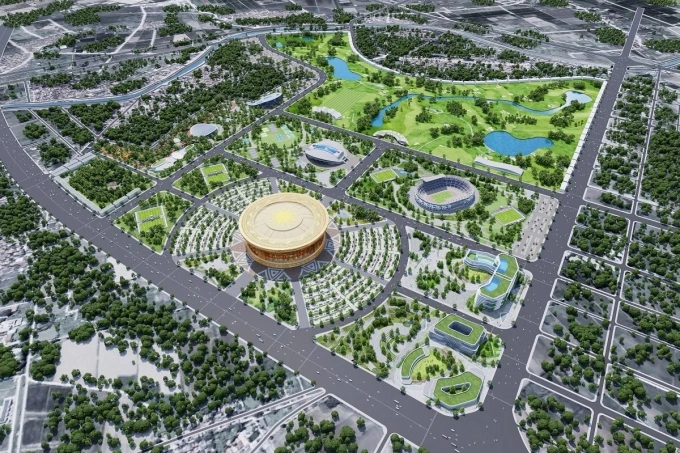
Vietnam’s largest private conglomerate Vingroup commenced construction on an Olympic sports urban complex spanning more than 9,171 hectares in southern Hanoi. With a total investment of approximately VND925 trillion (US$38 billion), the project is the largest urban development in Vietnam’s history. The development covers 11 communes, Dai Thanh, Ngoc Hoi, Nam Phu, Thuong Tin, Hong Van, Chuong Duong, Thuong Phuc, Binh Minh, Tam Hung, Thanh Oai, and Dan Hoa.
 |
|
Hanoi Party Secretary Nguyen Duy Ngoc and Vingroup Chairman Pham Nhat Vuong. Photo by Giang Huy |
The complex is designed with four distinct sub-zones aimed at establishing a world-class sports and service hub. This integrated urban area is intended to elevate Hanoi’s status as a global destination for culture and athletics, meeting the rigorous standards required to host premier events such as the Asian Games and the Olympic Games.
The centerpiece of the project is the Trong Dong (Bronze Drum) Stadium, located in Sub-zone B. Built on over 73 hectares, this FIFA-standard venue will feature 135,000 seats, making it one of the largest stadiums in the world. Its design includes the world’s largest retractable roof and is inspired by Vietnam's traditional cultural heritage. Vingroup expects to complete the stadium by August 2028.
 |
|
An artist's impression of the project. Photo by the investor |
The project’s master plan outlines a synchronized ecosystem across its four zones: Sub-zone A is a new urban district developed under the Transit-Oriented Development (TOD) model, serving as a primary transport hub to connect the city with the sports complex, while sub-zones C and D will consist of sports-focused urban residential and service spaces. They will include large-scale training facilities and event venues, providing a continuous landscape for elite competition, athlete training, and tourism services.
The Vietnam Expressway Development Investment Corporation (VEC) inaugurated the Binh Khanh Bridge, a centerpiece of the Ben Luc – Long Thanh Expressway project. Spanning the Soai Rap River, the bridge now serves as the tallest bridge in Vietnam, boasting a record vertical clearance of 55 m to accommodate large seagoing vessels.
 |
|
The Binh Khanh Bridge spanning the Soai Rap River was inaugurated on the morning of Dec. 19, 2025. Photo by Ha Giang |
The bridge connects Hiep Phuoc Commune in the former Nha Be District with Binh Khanh Commune in the former Can Gio District in the city’s southern gateway. Costing more than VND3.7 trillion, the bridge is nearly 2.8 km long and over 30 m wide, comprising four traffic lanes and two emergency stopping lanes. The cable-stayed section is 750 m long, with a main span of 375 m; the remainder consists of approach roads and overpasses across Nguyen Van Tao and Nguyen Huu Tho roads.
Construction on the Binh Khanh Bridge originally began in August 2015 but faced a major setback in late 2018, when work was suspended due to funding shortages and regulatory hurdles. After a nearly five-year hiatus, construction resumed in March 2023.
The bridge is one of two critical cable-stayed structures on the 58-km Ben Luc Expressway.
To date, approximately 30 km of the expressway has been opened to traffic. Once the entire route is fully connected in 2026, it will link HCMC with neighbors Long An and Dong Nai provinces, reducing travel times between the southeast and southwest regions and bypassing the congested inner-city areas.
Vietnam Electricity (EVN) officially inaugurated and energized the project connecting the Con Dao special zone, which is now managed by Ho Chi Minh City, to the national power grid.
This landmark achievement provides the island with its first stable, continuous electricity supply, completely replacing the local diesel-generated power that previously served the area.
Invested by EVN with total capital of nearly VND5 trillion (US$190 million), the infrastructure includes a 110 kV Gas Insulated Substation (GIS), a compact, high-voltage electrical substation, and a transmission system spanning 103.7 km. The complex route stretches from Vinh Chau Ward in Can Tho in the Mekong Delta to Con Dao, featuring nearly 78 km of subsea cables laid at depths of 30–50 m, more than 17 km of overhead transmission lines, and 8.5 km of underground land cables.
 |
|
An overhead transmission line crossing the sea to deliver electricity from Can Tho to Con Dao. Photo by An Phuong |
Despite challenges from weather and difficult underwater geology, the project was completed in just over eight months, nearly 3.5 months ahead of schedule.
With a projected capacity of 54.5 MW by 2030 and 90.2 MW by 2035, the grid connection is expected to catalyze tourism and service development while improving the environment.
Long Thanh International Airport in Dong Nai Province reached an operational milestone on the morning of Dec. 19 as three major domestic carriers successfully completed official inaugural landings at the new gateway.
At 8:10 a.m., a Vietnam Airlines Boeing 787-9 carrying Permanent Deputy Prime Minister Nguyen Hoa Binh and high-ranking ministry officials arrived from Hanoi. This landing is recognized as the airport's first official flight, following previous technical trials.
The arrival was followed shortly by two Airbus aircraft. Departing from Ho Chi Minh City's Tan Son Nhat Airport 40 km away, a Vietjet flight touched down at 8:30 a.m., followed by a Bamboo Airways aircraft at 8:35 a.m. These non-commercial flights carried flight crews and technical personnel to support the day's testing and ceremonies.
 |
|
A Vietnam Airlines Boeing 787-9 aircraft lands at Long Thanh airport on the morning of Dec. 19, 2025. Photo by Phuoc Tuan |
Truong Phuong Thanh, Chief Executive Officer of Bamboo Airways, highlighted the strategic importance of the facility, noting that Long Thanh will significantly boost Vietnam’s international passenger and cargo capacity.
"This will open up opportunities for domestic airlines, including Bamboo Airways, to develop flight network strategies connecting Ho Chi Minh City with other destinations in Vietnam in the coming period," Thanh said. He added that the airline is currently studying operating plans to align with the airport's phased opening as Long Thanh transitions into a major Southeast Asian transit hub.
Concurrent with the landings, two vital road projects connecting to the airport were technically opened to traffic. The Ho Chi Minh City Ring Road 3 section passing through Dong Nai Province spans 11 km, including a 5-km expressway and two bridges crossing the Rach Chay River. Additionally, the 25C Road project (Section 2) was opened, linking Road No. 9 to Huong Lo 19 in Nhon Trach Commune to provide essential ground connectivity to the new site.
The Airports Corporation of Vietnam (ACV) officially inaugurated the expansion of International Passenger Terminal T2 at Hanoi's Noi Bai International Airport.
Completed in 18 months, the project was executed while maintaining safety for hundreds of daily flights. The expanded terminal now covers more than 200,000 sq.m, increasing its annual handling capacity from 10 million to 15 million passengers, with the potential to serve up to 18 million. This growth is supported by an increase in infrastructure, including the expansion of aircraft parking stands from 17 to 30 and passenger boarding bridges from 14 to 27.
 |
|
Self-service check-in kiosks at Noi Bai T2 terminal. Photo by Anh Duy |
Beyond the physical footprint, the expansion introduces Vietnam’s first comprehensive digital technology ecosystem at an international terminal. This breakthrough shift toward automation includes automated check-in kiosks, self-service baggage drops, and biometric-based security screening. Passengers can now utilize automated immigration lanes and facial recognition technology to optimize the boarding process and enhance the overall travel experience.
The terminal also prioritizes a "green airport" philosophy, utilizing an open design that maximizes natural light and incorporates calming green "breathing spaces".
Deputy Prime Minister Nguyen Hoa Binh attended the ceremony, observing firsthand as passengers immediately began using the self-service systems to print boarding passes and clear security via automated gates, significantly reducing wait times to several seconds compared to previous manual processes that took a couple minutes.