He encourages his own daughter to ‘Love as much as you need until you find the one that feels right.’
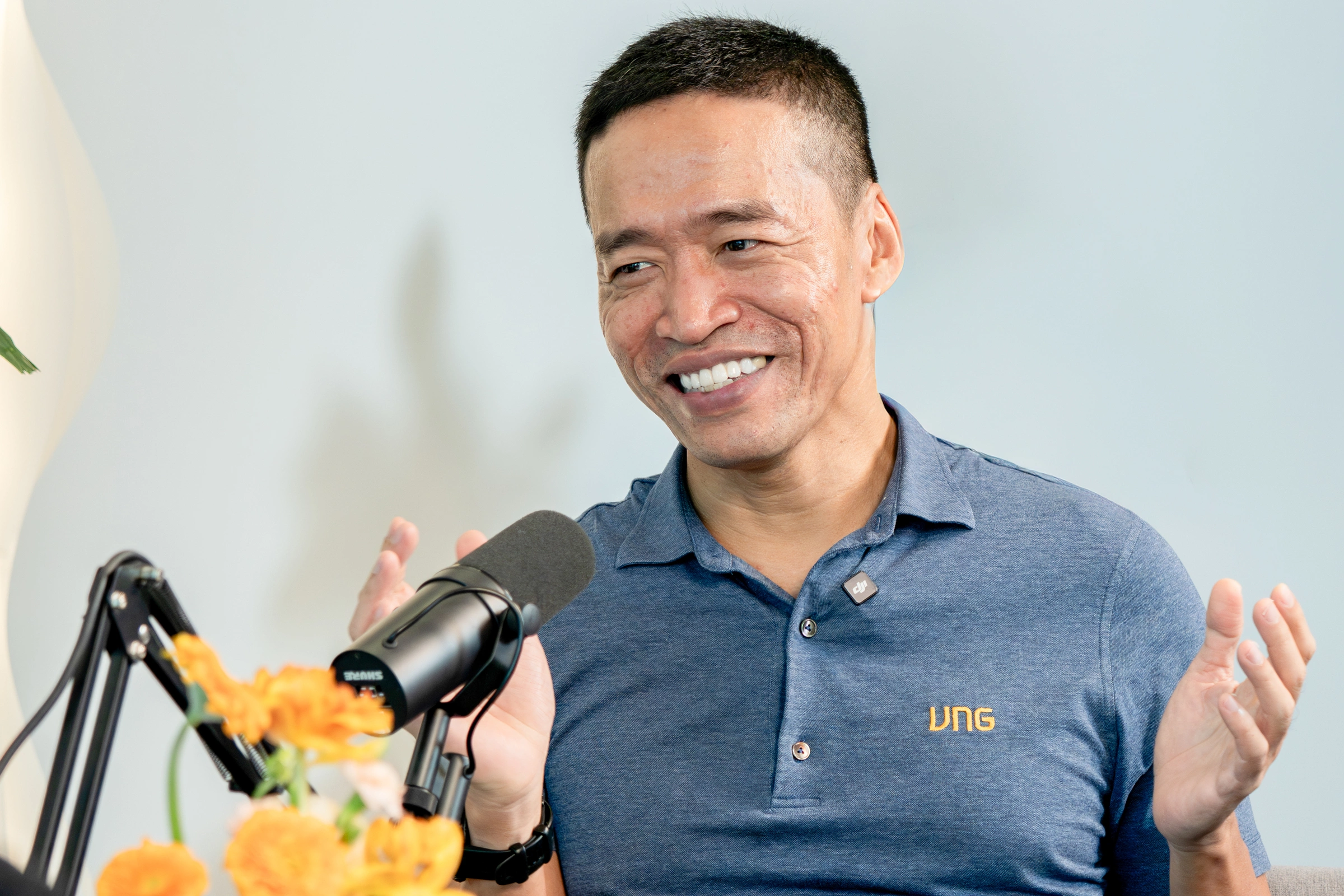
For 21 years of leading VNG from a small gaming room to a technology ecosystem with millions of users, he has lived by one philosophy: remain open, dare to dive into uncertainty, but always maintain one non-negotiable boundary: Try anything you want as long as it does not kill you.
In conversation with VnExpress, Minh reflects on experimentation, risk-taking and leadershipthat help sustain a long journey.
Starting with a passion for gaming shared among a group of friends, Minh entered the tech sector with the mindset of ‘just do it, and you'll figure out if it's right or wrong later.’
Two decades on VNG has navigated massive turning points, shifting from games to content platforms and digital services. In this conversation Minh shares his perspective on experimentation, facing risks and the boundaries he believes are essential to sustaining the journey.
Early days: 'Just try to survive'
— Looking back, what were the turning points that shaped your career path from that of a finance student to the founder of VNG?
— I was born after the war (1977) and grew up during a time when Vietnam was still impoverished. My parents were both state employees, and the singular dream of that era was to study hard enough to win a scholarship abroad.
At 18, I received a scholarship to study finance in Australia. I considered myself incredibly lucky to be part of the first generation to study overseas after the war, just as Vietnam began to open up. Four years in Australia almost completely altered my worldview: the knowledge, the ideologies and the approach to life were entirely foreign to me.
My second stroke of luck was encountering the Internet right in its infancy. In 1997, the moment I landed in Australia, a friend asked: ‘Do you have Hotmail yet?’ I didn't even know what it was. The first time I accessed the open Internet, I was overwhelmed. It was a new horizon.
I remember Microsoft acquiring Hotmail for $200 million just a few months after I created my account. The founders of Hotmail were only about 20 or 30 years old at the time. It was an epic story, and I nurtured a dream of building an Internet company.
I returned to Vietnam in early 2001 and worked for two foreign companies briefly before founding VNG on September 9, 2004. That was the third milestone.
Back then we were just five people with almost nothing but a burning passion for gaming. Vo Lam Truyen Ky, our first product, was successful beyond our wildest expectations.
— When you first bet on your own idea with a fledgling game company, what reality hit you after the explosive success of Vo Lam Truyen Ky?
— Immediately following the success of Vo Lam Truyen Ky came a barrage of challenges, technical, product-related, business, legal, and even social perception. From 2005 to 2007 we barely had room to breathe.
Everything was new; we had to learn how to operate a game, how to raise capital, and how to persuade banks that didn't even understand what the gaming industry was. User numbers grew so fast we couldn't afford enough servers; the whole team had to mobilize every resource, even begging partners to sell to us on credit.

Vinagame’s debut game, Vo Lam Truyen Ky, dominated internet shops across the country in 2005.
The hardest part was licensing. In late 2005 Vo Lam Truyen Ky faced the risk of being shut down because Vietnam did not yet have regulations for licensing online games.
In those early years the team struggled just to exist, motivating each other by saying ‘Let's just try to survive this month.’
By around 2007 things stabilized, and we finally sat down and asked each other: ‘Who are we, and what do we want?’ This is a hard question for an individual, but answering it as a collective was even harder.
Once I posted a photo of myself mountain climbing. Khai (Vuong Quang Khai – VNG co-founder) looked at it and said: ‘Why do we even need to discuss VNG's values? This is VNG's value: we love challenging ourselves, we love doing hard things.’
It was clear that in the previous three years VNG had done nothing but solve hard problems.
So we chose 'Embracing Challenges'. We added the 's' to 'challenge', meaning we welcome many challenges. And sure enough, plenty of challenges followed.
Later people would joke ‘Why did you add that s? Now we suffer every day!’ But eventually, it became a habit; if we didn't run into difficulties, it felt like something was wrong.
From there we decided not to just be a game company, but an Internet company.
That’s how Zing MP3 was born.
I set up a new team outside of gaming. We intended to call it the non-game team, but that sounded too unsophisticated, and so we named it the web-game team.
Product-building years: Challenges became norm
— At that time, many companies chose outsourcing, a path to quick, safe money with less effort. Why did VNG decide to develop its own products targeting end-users, a path that is costlier, riskier and longer?
— In 2007 we believed the Internet would revolutionize life, and if VNG wanted to contribute to that change, we had to create products that Vietnamese people used daily. That meant becoming a consumer technology company.
Our first self-developed product was Zing MP3 built by Khai's team.
At the time the most visited website in Vietnam was Yahoo, and we set a goal that sounded crazy: surpass Yahoo within 2007. Three months after launch Zing MP3 became the #1 website with one billion views per month.
That success gave us the belief that we could do it.
Afterward, we built many products: social networks, e-commerce, forums, and even a video platform similar to YouTube.
Of course, when you do a lot, you fail a lot, but those failures became part of us. VNG's method back then was to just build it and to fix it if it is wrong.
Even when building ZaloPay, we didn't know much about finance or electronic payments. But VNG's way was to gather the teams, say ‘Let’s do it,’ and learn everything from scratch.
In the first two years of building new products, we constantly asked ourselves: ‘Are we going the right way?’ It took immense effort and high costs, and we were building engineering teams without any users yet. We looked around and saw teams that simply bought products and generated immediate revenue.
But then we realized: they are doing business; we want to do technology. If it's technology, you must build the core yourself. Once we understood that was VNG's DNA, we just kept going.
— In 2009 VNG entered the phase of self-development, focusing on PCs. What was the biggest challenge of this ‘product startup’ era?
— Building a product isn't just a technical matter; it's about designing something that fits the tastes, needs and environment of Vietnamese users.
The biggest challenge early on was: choosing what to build, how to build it and who would do it.
Technically, creating a website like Zing MP3 or software like Zalo isn't overly difficult. The hardest part is attracting users. Whether for tens of thousands, millions or hundreds of millions of people, maintaining and continuously developing the product is a massive puzzle.
The Internet is a global market; once you enter it, you are competing with the strongest players in the world.
At the time VNG chose to leverage our local advantage.
VNG's first products like Vo Lam Truyen Ky and Zing MP3 were steeped in this element. When Zing Me faced off against Yahoo, we both had chat, email and blogs, but only Zing had music. That was the factor that helped Zing win.
Zing Me was focused on competing with Yahoo, but in the end the main segments didn't win, while Zing MP3, originally just a side project, succeeded.
The lesson is that there are many things you won't know until you try.
— Moving to 2012, VNG was at its peak on PC, yet you demanded the entire focus be shifted to mobile. Why did you make such a drastic pivot?
— 2012 was VNG's peak year for PC; revenues and profits were high. Gaming revenues were 100% derived from PC. But I told everyone: "Stop caring about that pile of revenue. The entire goal for next year is shifting to mobile."
The debate was fierce. Many argued that PC was still important. But I was adamant: Focus all energy on converting current products from PC to mobile.
Five years later, PC revenue was only about 15%. Mobile accounted for 85-90%. Looking back, if we hadn't switched early, VNG might not exist today.
That decision came from observation. Technology changes rapidly, and tech companies feel it the most acutely. I had seen many big names fail to pivot in time and become history: Yahoo, Nokia... You don't change because you see an opportunity; you change because you want to survive.
— When the majority of the team was hesitant about "abandoning PC for mobile," how did you convince them?
— The most important job of a leader is to clearly see what the team needs to do. I was afraid everyone would fall into a rhythm of inertia. Technology moves too fast; if we don't watch the world around us, we will miss the beat instantly.
Secondly, you have to be brave, tenacious and willing to challenge the status quo.
VNG wasn't huge back then, but it was a sizable company; disagreement was normal. We accepted different viewpoints and methods, trying two or three different directions. Simply put: everyone is climbing the same mountain peak, but via different paths, as long as we all reach the summit together.
The hard years: lessons learned through loss
— In VNG's mobile era many products succeeded in terms of user numbers -- Zalo with 80 million monthly users, ZaloPay with over 16 million -- but the profits were not commensurate. How do you view the ‘high users, low revenue’ dilemma?
— In the tech industry, that is perfectly normal. The nature of this industry is that the product comes first, then users and revenues come last. Tech giants like Facebook, Google, Amazon, and ChatGPT all follow this principle.
When a new product is born, the priority is getting people to use it. To attract and retain them, you must invest massive amounts of time and money. This standard formula causes tech companies to often operate at a significant loss initially.
For instance 95% of ChatGPT users in Vietnam use the free version, yet OpenAI (the parent company) is valued at $500 billion. They lose about $5-6 billion a year, but their business plan involves investing $1 trillion over the next 5 years in infrastructure and chips because they believe this is a competitive advantage no rival can match.
Zalo and ZaloPay follow that principle.
Of course, the risk in tech is that you might be wrong; you might fail. Investing in a product does not guarantee you'll reach the mass-user stage, let alone the revenue stage.
The tech industry is fiercely competitive; usually, only a few players survive in each segment. To know if you are right or wrong, you have to see the journey through to the end.
— In 2023, VNG lost more than VND2.3 trillion (US$87.35 million) due to investments in mobile products like Tiki and Telio. Did you ever revisit your ‘embracing challenges’ philosophy and consider retreating to the safe haven of gaming?
— The philosophy of ‘embracing challenges’ has not changed. But I certainly have to reflect on what went wrong and how to fix it. Starting around 2018, amidst the euphoria of the Internet and financial markets, the whole world invested in mobile Internet companies. VNG also felt that if we were not bold or brave, we might miss huge opportunities. This is the FOMO (fear of missing out) that individuals and organizations experience.
When you are wrong, you have to pay the price. The 2022-2023 period was the year we paid the price for over-investing previously. You have to go through it and lose a lot of money for it to truly become a lesson. But that debt is nearly paid off now.
When you see mistakes, the first step is adjustment: Persevere with what is important; abandon what is unimportant or wrong.
I often tell everyone: ‘Try anything you want, just don't crash. And if you crash, don't let it be fatal.’ When it gets too hard, learn from it, accept falling back a step, and then persevere step-by-step to climb back up.
— Throughout your journey with VNG, you've experienced many highs, lows and leadership pressures. How do you overcome difficult periods?
— I always think that, no matter what terrible things happen, it is fine as long as I don't die. The way to be happy is to cherish what you currently have. Every morning I wake up healthy, doing what I love, surrounded by teammates and people I cherish—what more could I want? Everything else is solvable.

Whenever I face a difficult problem, I return to my basics.
The second important thing is that I deeply cherish my relationships. These are the people who help me, share with me, and for many, they are the reason I wake up to work; they are my daily life. Family, for instance, is the reason I push myself.
For me, mental health stems from physical health. I participate in marathons and triathlons. I have not missed a race in 10 years though I’m slow. I apply the running philosophy to life: choose a distance that fits your strength; you can go slow, but with persistence you will reach the finish line. Don't worry about running fast because, if not this race, there’s always another.
The past 21 years had many difficult moments, but my teammates at VNG and I always had faith in our work. If we get too tired, we tell each other to rest a bit. It's like mountain climbing; you don't always have the stamina to keep going. If you are tired, sit down and rest.
Of course, you can't always maintain peak energy; sometimes I feel deflated, and that is when the environment and teammates help me through.
The most important thing is that the organization must help everyone discover their inner strength and believe that, together, we can achieve great things. I believe anyone can do great things; they just need to want it enough.
"When the value is good enough, money will follow"
— In 21 years VNG has gone through three stages. For you personally, how do you divide your 21-year journey?
— First was the process of learning acceptance. Accepting change as the company grew from a small startup, where we worked and played with close friends, to something larger, facing choices where not every friend could continue the journey with me.
Relationships with family, friends and colleagues are extremely precious to me, and so I feel sad when a close friend departs. But that is part of life and work. I have to accept there will be times they choose a different path; I must keep walking, and new companions will appear.
The second stage was questioning myself: Am I capable enough for the top position? Did I make the right decisions? Have I fulfilled the responsibilities of a leader? The answer was often ‘no,’ and sometimes I felt my capability was insufficient.
Later I read a book by the CEO of IBM who wrote ‘only the paranoid will survive,’ meaning only those who are hyper-vigilant can survive. I’ll flatter myself for a moment and put myself in that ‘hyper-vigilant’ group.
Worrying is good because it highlights risks, but sometimes it creates immense stress. I had to overcome that phase: be confident enough, but also self-aware enough to know my weaknesses and which decisions I simply have to accept.
The third challenge wad the common question for many leaders in Vietnam: Once the business has grown, what do I do, and what is the meaning of it? People might simplify it as ‘businesses just need to make money, why ask complicated questions?’ But I feel differently. Making money is the result of answering the question of value. Just like in martial arts when everyone learns the moves in the beginning.
Similarly, in business, you learn to make money. But after that, you must think deeper—what value am I creating? When the value is good enough, money will follow. This is a hard question. Once you've climbed to the peak, you have to decide which peak to climb next and what meaning that new path holds.
Over 21 years the luckiest thing for me has been accumulating a wealth of experience—from personal values and corporate values to ways of thinking, learning and working. When I started I only had faith and enthusiasm. Fortunately, that faith wasn't crushed by overwhelming challenges. I overcame those hurdles, and now that faith has transformed into inner confidence.
— Do you have any suggestions for young people entering the world with the same faith you once had but in today's more competitive context?
— The environment has changed, and the pressure is high, but I believe some basic principles remain the same. First, if you persevere, you will achieve what you want. Even if the mountain you want to climb is Everest, I believe anyone can achieve it if the goal is important enough and they are persistent enough.
Second, the harder part, and I think many people struggle with this, is answering the question ‘What do I want?’
Many young people worry because they don't know what they want yet, but I think that is okay. Youth is the phase where you have the right to try and the right to be wrong.
Many wonder if job-hopping too much is a bad thing or dating too many people is a problem. I think it's fine as long as you don't crash and burn. I often share this with my daughter, hoping she will date plenty of people before deciding to marry. You have to experiment to know what is truly suitable for you. Just explore, and the answer will come from your own experiences over time.
Content: Leo Doan - Thuy Ngan
Video: Bao Quyen - Ky Anh - Kim Long - Trung Kien
Graphics: Kim Long - Leo Dang