
The most read Vietnamese newspaper
Edition: International | Vietnamese
© Copyright 1997 VnExpress.net. All rights reserved.
 |
|
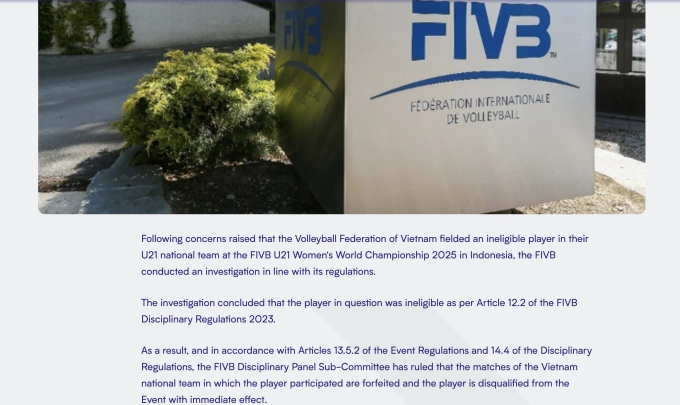
An announcement published on FIVB's website on Aug. 12, 2025 to punish Vietnam at the U21 Women's World Championship. |
In a statement posted on the evening of Aug. 12, the federation, commonly known by the acronym FIVB (Fédération Internationale de Volleyball), said it had received a complaint regarding a Vietnamese player at the ongoing U21 World Championship in Indonesia. Following an investigation, the federation concluded the player was "ineligible" to compete under FIVB Disciplinary Regulations.
As a result, the player was disqualified, Vietnam's results in matches involving the player were annulled, and the team was fined 30,000 Swiss francs (US$37,200). The player, the team, and related officials could also face suspensions of up to two years.
Vietnam's wins over Serbia, Canada, and Indonesia were turned into 0-3 losses, and their 1-3 defeat to Argentina changed to 0-3. The penalty dropped Vietnam from second place in the group to last, forcing them into the 17th-24th classification matches instead of competing for a semifinal berth.
The penalty was issued by the FIVB Disciplinary Subcommittee, which must inform the main Disciplinary Board within 24 hours after the tournament so additional sanctions can be considered if necessary. Under FIVB Disciplinary Regulations, the Subcommittee's decision is final, meaning Vietnam could no longer compete in the championship group.
FIVB did not publicly disclose the reason for the ineligibility. However, under Article 16.6.4 of the regulations, it must inform the concerned parties — in this case, the player and the Vietnam Volleyball Federation (VFV) — of the reason, the deadline, and the appeals process at the appropriate time. This notification is not required to be published online.
Similar cases have occurred before. In March 2022, FIVB announced that four Rwandan women's players were ineligible for the 2021 African Championship and banned them for 10 months without detailing the reason. According to InsideTheGames, the players were Brazilian nationals who had not completed Rwanda’s naturalization process. Nigeria lodged a complaint during the tournament, leading to Rwanda’s disqualification despite being the host nation.
This practice is not unique to FIVB. The International Football Federation (FIFA) also avoids publicizing specific reasons for ineligibility. In the 2018 World Cup qualifiers, Bolivia fielded an ineligible player, Nelson Cabrera, who had only lived in Bolivia for four years instead of the required five. FIFA’s announcement did not detail the violation in mass media.
Both FIFA and FIVB, headquartered in Switzerland, have "quasi-judicial" autonomy, meaning they operate internal court systems to handle disputes and rule violations. According to the sports law site Sportlegis, they often release only brief public statements to avoid legal risks and share details selectively when deemed safe and necessary.
Under FIVB Sporting Regulations, players can be deemed ineligible for reasons such as: lacking nationality, not completing nationality change procedures, exceeding the age limit for age-restricted events, violating gender eligibility rules, playing while suspended, or failing an identity check.
 |
|
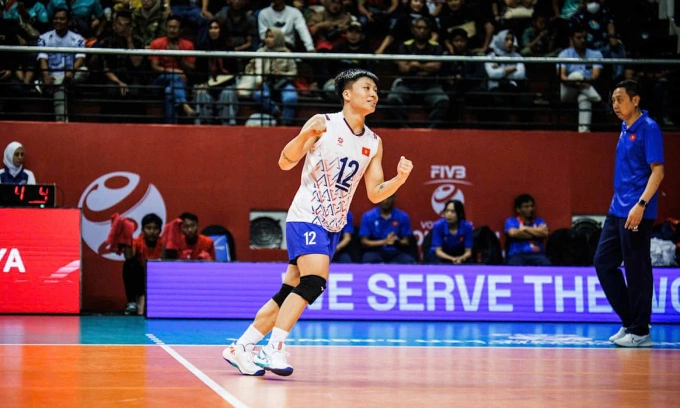
Player Dang Thi Hong in Vietnam and Indonesia's 3-0 victory in Group A of the 2025 FIFA Women's U21 Volleyball World Cup in Surabaya, Indonesia on Aug. 7, 2025. Photo by World Volleyball |
Speaking to VnExpress on Aug. 13, VFV General Secretary Le Tri Truong affirmed that Vietnam complied with all regulations when entering the U21 World Championship.
"I affirm that the athletes and the federation submitted all the required documents and didn't cheat or falsify their personal records."
Tournament rules require players' personal records to be verified with birth certificates before the competition and checked again at a technical meeting one day before matches begin. On Aug. 11, a day before the final group stage games, Vietnam's coaching staff received notice from VFV that the organizers wanted to check the records of three players, including their original birth certificates, and conduct blood and urine tests.
VFV worked with families and clubs to translate the documents and send them to FIVB. All personal details — full name, date of birth, hometown, gender, and parental information — matched. However, one player’s birth certificate was issued a year after their actual birth, and another's was issued two years later.
As a result, both players missed the Aug. 12 match against Puerto Rico. On Aug. 13, attacker Dang Thi Hong was barred from playing against Egypt and sat in the stands.
"We explained that the birth certificate delay was because the athletes came from rural areas, and this was common in Vietnam at the time," Truong said. "FIVB accepted this explanation. But on Tuesday night, they still concluded that one athlete was ineligible to compete and issued a penalty."
On gender eligibility, Truong noted that FIVB, like many other federations, treats it as a private matter: "They do not require testing, relying only on birth certificates as the legal basis. But they can conduct tests if there are complaints from other teams. However, what decides an over-standard index or a violation is not clearly stated in the regulations."
VFV has consulted with authorities and lawyers to submit an official complaint to FIVB, seeking clearer definitions of violations to protect athletes’ rights and the reputation of Vietnamese volleyball.


