
The most read Vietnamese newspaper
Edition: International | Vietnamese
© Copyright 1997 VnExpress.net. All rights reserved.
Here are the six biggest financial mysteries in football that still have not been answered to this day:
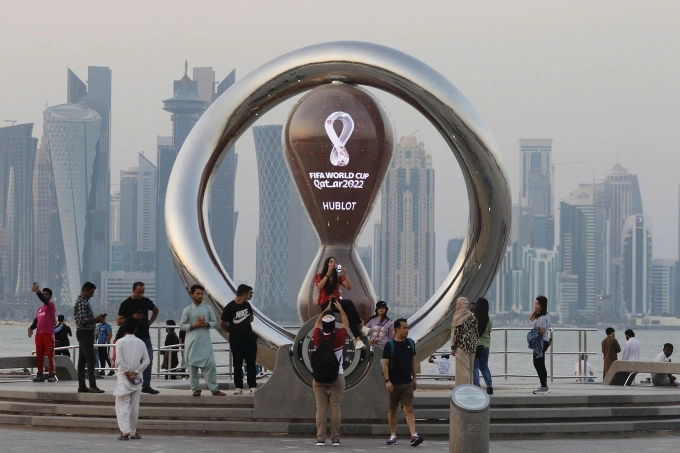
How much did the 2022 World Cup really cost?
 |
|
The 2022 World Cup countdown clock in Doha, Qatar on Oct. 12, 2022. Photo by Reuters |
Qatar's 2022 World Cup attracted attention with its announced US$229 billion infrastructure cost over 11 years. This figure crushed previous World Cup spending, with South Africa spending $3.3 billion in 2010 and Brazil $11.6 billion in 2014.
However, FIFA admitted that only $6.5 billion went toward the tournament's eight stadiums and organizing facilities. Much of the remaining cost is attributed to Qatar's Vision 2030, including projects like the Doha Metro ($36 billion), Hamad International Airport renovation ($13 billion) and Lusial City, according to BBC Radio. Qatar counted these projects as expenses related to the World Cup.
Should this be considered a cost of organizing the tournament, or a cost for national development in which the World Cup only plays a role? Sports economists argue that, excluding national infrastructure costs, the true cost of the 2022 World Cup is closer to $15-20 billion, not the staggering $229 billion as announced.
Despite the massive investment, Qatar's returns from tourism, tickets and broadcasting were modest. The true value lies in the nation's attempt to present itself as a global sports hub.
Barcelona and the Negreira referee scandal
 |
|
The referee gives Barcelona's Sergio Busquets a yellow card during a La Liga game. Photo by AFP |
Over 17 years, Barcelona paid $8.5 million to the DASNIL 95, the company of Jose Maria Enriquez Negreira, former vice president of Spain’s Technical Committee of Referees (CTA), according to The Athletic.
Barca claimed these payments were for "referee analysis reports" to help players understand refereeing trends. However, there was no evidence that the company provided such services. The controversy arose from Negreira's role, which allowed him to influence referee assignments, sparking accusations of bribery.
While Barca denied any wrongdoing, the club's image was tarnished. Investigations have yet to reach the final conclusion. If corruption is proven, this will be the biggest scandal in Spanish football history. If not, Barca still face the question: Why did a big club like them make regular payments to a referee's company for nearly two decades?
2018 and 2022 World Cup hosts: What was exchanged for the votes?
 |
|
The World Cup opening ceremony on June 14, 2018 in Russia. Photo by Reuters |
The decisions to award the hosting rights of the 2018 World Cup to Russia and the 2022 World Cup to Qatar raised suspicions. Both countries, with little football tradition, beat out football powerhouses like the U.K., the U.S. and Japan, leaving many questions.
Lawyer Michael Garcia, who was assigned by FIFA to investigate the case, revealed lavish trips, questionable sponsorships and private meetings between FIFA officials and representatives of these countries in a 430-page report. However, FIFA only released a shortened version of the report with 42 pages in September 2014, with the author being another lawyer and concluded there was "no decisive evidence". Garcia immediately resigned and claimed the report was falsified, The Guardian reported.
After that, FBI and other European investigation agencies arrested many FIFA officials for corruption, but most of the allegations were related to the broadcasting rights scandal and not the World Cup in Russia and Qatar.
To date, the question of what the votes were exchanged for remains unanswered.
Manchester City and 115 financial violations allegations
 |
|
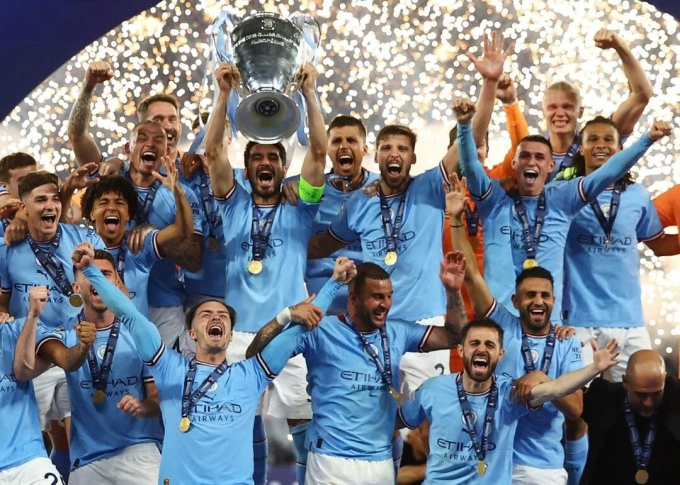
Man City lift the Champions League title at Ataturk Stadium, Istanbul, Turkey on June 11, 2025. Photo by Reuters |
Manchester City, a mid-table club turned powerhouse thanks to the financial power of the owners from the UAE, faced 115 financial violations from the Premier League, including falsifying revenue from sponsorship, concealing player payment, violating information disclosure regulations and failing to cooperate with investigations.
The focus is on sponsorship deals with companies directly linked to Abu Dhabi, the group that owns the team. The Premier League suspects these deals are valued unusually high to pump money into the team to bypass Financial Fair Play.
In the secret hearings at the end of 2024, Manchester City firmly denied the allegations and claimed that all of their activities are legal, according to Sky Sports. If found guilty, Man City can face far-reaching consequences, potentially stripping the club of their titles and giving them to other big clubs.
Was there a slush fund for the 2006 World Cup?
 |
|
German football legend Franz Beckenbauer, president of the 2006 World Cup organizing committee. Photo by AFP |
The 2006 World Cup in Germany was dubbed "Sommermärchen" or "summer fairy tale" by Germans. However, nearly a decade later, German newspaper Der Spiegel revealed questionable financial dealings behind the campaign to win the World Cup hosting rights.
According to the investigation, the German bidding committee allegedly created a fund of $12.4 million to spend on unclear expenses, including $7.6 million from the Adidas CEO at that time, Robert Louis-Dreyfus. Some of which was funneled to FIFA under the guise of a cultural program, then returned to the organizers. This sketchy way of transferring money around has raised a question of whether this is a slush fund used to buy votes for the hosting rights.
Important figures such as campaign chief and football legend Franz Beckenbauer have repeatedly denied this. At the time, the German Football Association only admitted that the $7.6 million had been misused and that it was under investigation.
However, since then, key documents have disappeared and the case has been suspended due to the statute of limitations. The 2006 World Cup is still remembered as a football festival, but a layer of financial dust has covered the clean image of German football.
Parallel contracts and Neymar's record transfer fee
 |
|
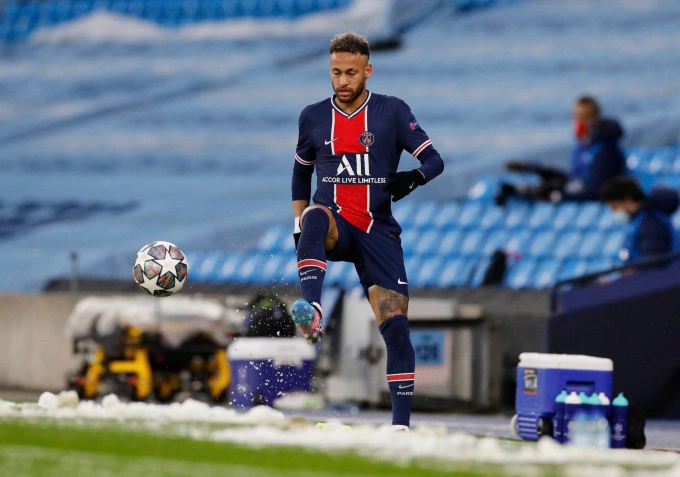
Neymar during the second leg of PSG's Champions League semifinals against Man City on May 4, 2021. Photo by Reuters |
The transfer of Neymar to Barcelona in 2013 raised eyebrows when parallel contracts were revealed. While Barcelona initially reported the fee as $66 million, the actual figure was more than $93 million when these hidden contracts were disclosed in court.
The parallel contract was reportedly made to convince Neymar and his family to choose Barcelona over Real Madrid. According to Reuters, Santos only received a transfer fee of $20 million while the rest went to Neymar and his family.
Neymar's 2017 move to Paris Saint-Germain for a record $253 million also raised questions. Many sources believe that the money came from the Qatar Sports Investments (QSI) group, in the form of a "highly valued" sponsorship contract to circumvent Financial Fair Play.
Also in the summer of 2017, PSG signed Kylian Mbappe from AS Monaco on loan, with an obligation to buy the French striker after a year for $210 million. PSG's case is somewhat similar to Man City, when their sponsorship contracts are unusually high.
UEFA opened an investigation, but no penalty was given.
These six cases highlight the financial intricacies behind football's success, where tactics and goals are often overshadowed by vast financial backing. Some of these mysteries may never be fully resolved, as time and legal limitations prevent further investigations.


