
The most read Vietnamese newspaper
Edition: International | Vietnamese
© Copyright 1997 VnExpress.net. All rights reserved.
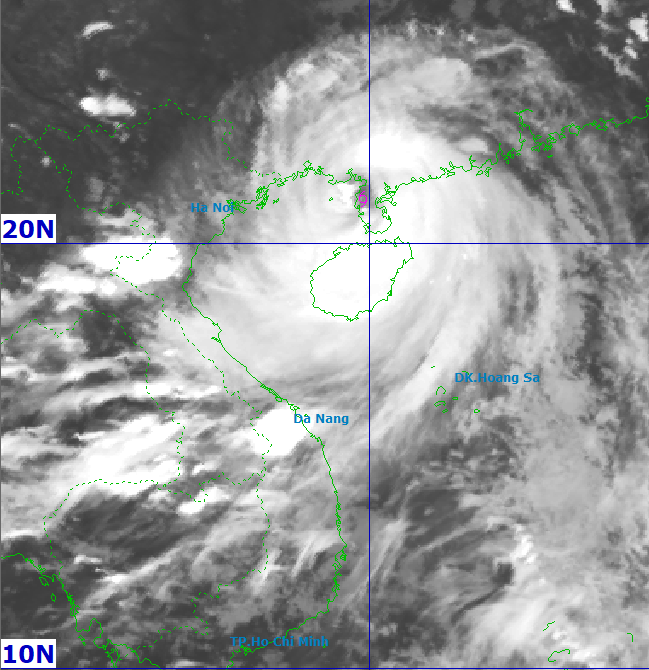
Matmo lay centered over China's Leizhou Peninsula, about 210 km from Mong Cai of Vietnam's Quang Ninh Province, at 5 p.m. Sunday, with maximum sustained winds near 133 kph, according to the National Center for Hydro-Meteorological Forecasting. Terrain friction after lashing China's southern coast has weakened the storm slightly from Sunday morning.
Maintaining a west-northwest track at about 20 kph, the storm is expected to move over the Gulf of Tonkin in the coming hours and reach Guangxi Province's mainland by around 4 a.m. Monday with sustained winds around 62–88 kph. It will then skirt the Vietnam–China border, weakening to a tropical depression and later a low-pressure area over the northern mountains.
Japan Meteorological Agency estimates Matmo's sustained winds at 126 kph, easing to about 90 kph near landfall on the Vietnam–China border. Hong Kong Observatory expects it to weaken to a tropical depression over Vietnam's Cao Bang Province which borders China.
Mai Van Khiem, director of Vietnam's national forecasting center, said the storm’s circulation is relatively broad, so strong winds on land are likely from Sunday night through midday Monday. In addition to wind, authorities and residents should prepare for heavy rain, especially in the northern midlands and mountains.
There is also high risk of flash floods and landslides. During Typhoon Bualoi, heavy rain saturated soils across the northern midlands and mountains, and multiple landslides were recorded.
"With Matmo's rain, the risk of landslides and flash floods in the midlands and mountains is very high," Khiem warned, urging localities to review and evacuate vulnerable areas.
 |
|
Satellite image of Typhoon Matmo at 5 p.m. on Oct. 5, 2025. Photo courtesy of the National Center for Hydro-Meteorological Forecasting |


